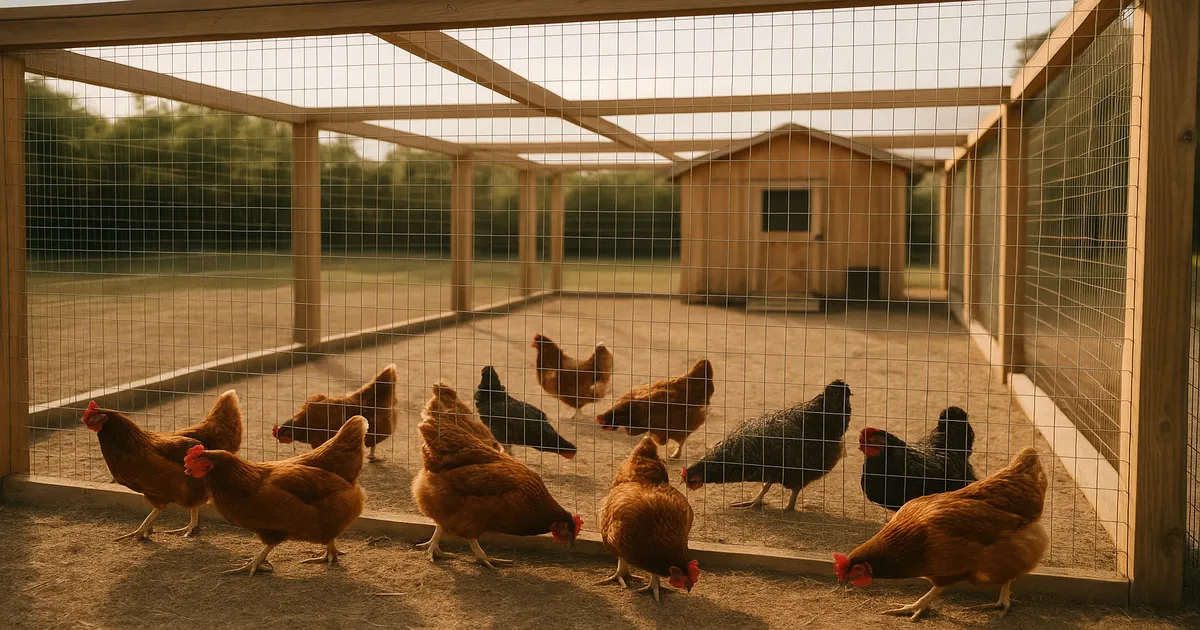
Quick Answer: Yes, plenty of backyard chicken keepers never free range — and their flocks are just as healthy and productive as any roaming flock. With the right breed, adequate space, solid nutrition, and a few enrichment strategies, a well-designed run-only setup is a completely legitimate choice. This guide covers everything you need to do it right.
Does Anyone NOT Free Range? More Than You’d Think
The question comes up constantly in chicken-keeping forums: does anyone not free range? The answer is a resounding yes — and for good reason. Urban and suburban keepers, renters, HOA members, and anyone living in predator-heavy territory often find that a secure, well-designed confined setup is simply the smarter choice.
The most common reasons are straightforward:
- Predator pressure — Hawks, foxes, raccoons, and dogs make free ranging a gamble in many areas
- HOA rules or local ordinances — Some neighborhoods restrict where chickens can roam
- Limited yard space — A small suburban lot doesn’t leave much room for safe free ranging
- Renter restrictions — Not everyone can modify a yard they don’t own
- Neighbor relations — Confined chickens stay out of neighboring gardens
If you have fewer than a quarter-acre, live somewhere with active predators, or simply want to know your birds are safe while you’re at work, confinement is a smart call. The key is building a setup that meets your flock’s physical and behavioral needs — which is exactly what this guide walks you through.
Best Chicken Breeds for Confined Keeping
Breed selection matters more when you’re not free ranging. High-energy, flighty breeds that can’t burn off steam will become stressed, start feather-picking, and generally make your life difficult. Calm, adaptable breeds thrive in runs.
Heavy and Dual-Purpose Breeds That Tolerate Confinement
- Buff Orpington — The gold standard for confined keeping. Docile, friendly, and genuinely unbothered by a well-sized run. Hens weigh 7–8 lbs and lay 3–5 brown eggs per week.
- Australorp — Calm, quiet, and prolific. An Australorp hen can lay 5–6 eggs per week (250–300 per year), making it one of the best all-around confined breeds.
- Plymouth Rock (Barred Rock) — Curious and adaptable without being flighty. Consistent layers of brown eggs at 4–5 per week and easy to handle.
- Wyandotte — Beautiful laced plumage, a rose comb that resists frostbite, and a laid-back temperament that suits run life well. Lays brown eggs at 3–4 per week.
- Sussex — Inquisitive without being hyperactive. The Speckled Sussex in particular stays busy exploring even a modest run, laying 4–5 light brown eggs per week.
- Rhode Island Red — Slightly more assertive than the others, but highly productive (5–6 brown eggs per week) and manageable in a properly sized space.
Bantam Options for Small Urban Spaces
If you’re working with a genuinely small footprint, bantams are worth serious consideration. They need only 2–3 sq ft of coop space per bird and are well suited to tight urban setups.
- Silkie — Extremely docile, famously broody, and endlessly entertaining. Lays small cream or tinted eggs.
- Cochin Bantam — Feather-footed and calm; great with children. Lays small brown eggs.
- Belgian d’Uccle — Friendly and easy to manage, with a charming bearded appearance. Lays small cream eggs.
Breeds to Avoid in a Run-Only Setup
Some breeds genuinely struggle in confinement — it’s not about being cruel, it’s just a poor match.
- Leghorn — High-strung and flighty; stress-prone in enclosed spaces
- Hamburg — Nervous temperament; does poorly without wide-open space
- Ancona — Active Mediterranean breed that needs room to roam
- Old English Game — Aggressive and built for activity; confinement causes behavioral problems
Confinement Temperament Ratings at a Glance
| Breed | Confinement Score (out of 5) |
|---|---|
| Buff Orpington | 5/5 |
| Australorp | 5/5 |
| Plymouth Rock | 4/5 |
| Wyandotte | 4/5 |
| Sussex | 4/5 |
| Rhode Island Red | 3.5/5 |
| Leghorn | 1/5 |
Coop and Run Space for Confined Flocks
This is where most people go wrong — and where getting it right makes the biggest difference. Confined birds spend 100% of their time in your coop and run, so space is non-negotiable.
Indoor Coop Space
The often-cited minimum of 4 sq ft per standard bird is exactly that — a minimum. Behavioral problems like feather-picking and aggression start showing up at or below that threshold. For a run-only flock, aim for 6–8 sq ft per standard bird inside the coop. Heavy breeds like Buff Orpingtons and Wyandottes do best with 8–10 sq ft. Bantams can manage with 2–3 sq ft per bird.
Run Size
- Minimum: 10 sq ft per bird
- Recommended for full-time confinement: 15–20 sq ft per bird
- Ideal: 25+ sq ft per bird — at this size, boredom and aggression problems are rare
For a flock of 6 standard hens, that works out to a minimum 36 sq ft coop plus a 60–120 sq ft run. More is always better. If you’re building from scratch, build bigger than you think you need — you’ll thank yourself later.
Roosts, Nesting Boxes, and Ventilation
Use rough-sawn 2×4 lumber laid flat (4-inch side up) for roost bars. The flat surface lets birds cover their feet with their body feathers in cold weather, preventing frostbite. Allow 8–12 inches of linear space per standard bird, mount bars 18–24 inches off the floor, and space multiple bars 12–18 inches apart horizontally.
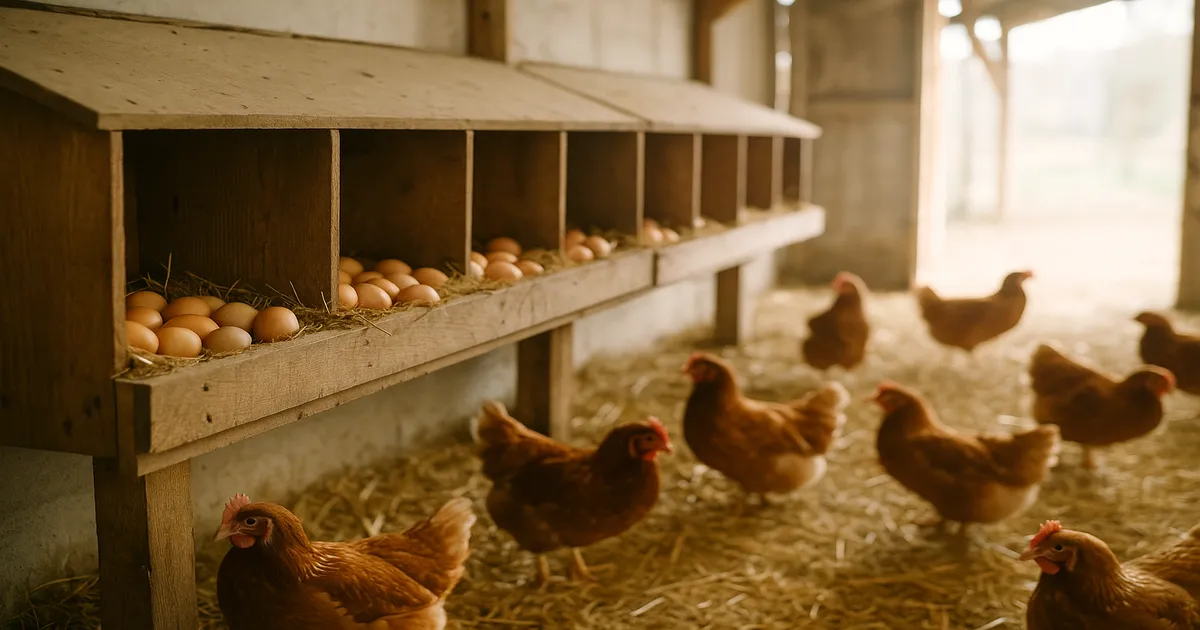
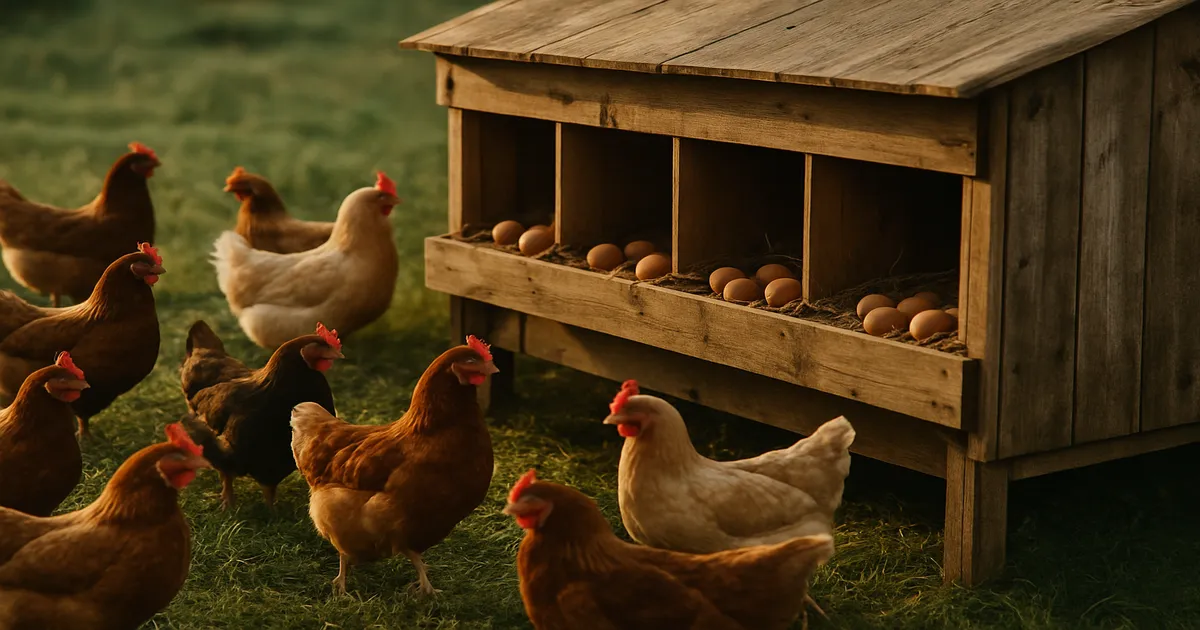
For nesting boxes, one box per 4–5 hens is the standard — hens genuinely do share favorites. Standard boxes should be at least 12×12 inches; go 14×14 for heavier breeds. Mount them lower than the roosts so birds don’t sleep (and poop) in them. Simple burlap curtains across the front reduce egg-eating and give hens the privacy they prefer.
Ventilation matters more than insulation. Aim for at least 1 sq ft of ventilation opening per 10 sq ft of coop floor space, positioned high on the walls near the roofline. This lets ammonia and moisture escape without creating drafts at bird level. If you can smell ammonia when you open the coop door, your ventilation is inadequate — ammonia above 25 ppm causes real respiratory damage. Cover all vents with ½-inch hardware cloth.
In climates that regularly drop below 20°F (-7°C), insulate walls and ceiling to R-13 to R-19. Skip the heat lamp — they are a leading cause of coop fires and are rarely necessary for healthy adult birds. The deep litter method is a better solution: build up 6–12 inches of pine shavings and let it compost slowly over winter. Microbial activity generates enough passive heat to raise coop temperature 5–10°F on its own, and a dry cold coop is always healthier than a warm humid one.
Predator-Proofing a Confined Run
Here’s an underrated advantage of not free ranging: you can build a genuinely predator-proof enclosure. Free-range birds are always at some level of risk. A properly built run doesn’t have to be.
Chicken wire keeps chickens in. It does not keep predators out. Raccoons can tear through it; foxes can bite through it; weasels can slip through the gaps. Use ½-inch hardware cloth on all walls, the roof, and any openings. Yes, it costs more. It’s worth every penny.
To stop digging predators, add an apron skirt: lay 12–18 inches of hardware cloth flat on the ground around the run’s perimeter, securing it with landscape staples. Predators that start digging at the base of the wall hit the apron and give up — they don’t think to step back and dig further out.
An automatic coop door (ChickenGuard Extreme) on a timer or light sensor closes reliably at dusk even when you’re not home. For latches, use padlocks or carabiner-style clips on every door — raccoons are disturbingly good at opening simple barrel bolts and hook-and-eye latches.
A fully covered run — hardware cloth, welded wire, or heavy-gauge bird netting — eliminates aerial predation from hawks entirely and stops climbing predators like raccoons from going over the top.
Feeding Confined Chickens: Nutrition They Can’t Forage for Themselves
Free-range birds self-supplement constantly — picking up insects, greens, seeds, and grit as they roam. Confined birds rely entirely on you for complete nutrition.
For laying hens, use a layer feed with 16–18% protein. Pellets are the best choice for confined flocks — they produce the least waste and are harder for birds to scatter. Each standard hen eats roughly ¼ lb (about ½ cup) per day; a flock of 6 goes through about 10.5 lbs per week. During molt, switch to a flock raiser or high-protein supplement at 20–22% protein to support feather regrowth.
Always offer #2 granite grit free-choice in a separate container. Chickens grind food in their gizzard using small stones, and confined birds can’t pick up grit naturally. Without it, they can’t properly digest whole grains, scratch, or fibrous treats.
Offer oyster shell free-choice in a separate dish so hens can self-regulate calcium intake. Soft or thin-shelled eggs are a reliable sign that calcium is insufficient. Crushed eggshells baked at 250°F for 30 minutes are a free alternative — just make sure they don’t look like whole eggs or you may encourage egg-eating.
Treats should make up no more than 10% of your flock’s daily diet. Safe options include leafy greens, mealworms (about 1 tablespoon per bird per day) , cooked eggs, berries, cooked squash, and oats. Avoid avocado (toxic — contains persin), chocolate, raw beans, onions, and moldy food of any kind.
Fermented feed is worth trying. Soak layer pellets in water for 3 days at room temperature, stirring daily. Fermentation increases nutrient bioavailability and can reduce feed consumption by 20–30% while improving gut health. Fodder trays — sprouted barley or wheat grown on shallow trays indoors — provide fresh greens year-round. Slide a tray into the run every few days and watch your flock go to work.
Does Anyone NOT Free Range and Still Have Happy Chickens? Yes — Here’s How
Boredom is the biggest behavioral risk in a run-only setup. Bored chickens feather-pick, become aggressive, and lay fewer eggs. The fix is straightforward: give them things to do.
Feather-picking often starts with one bird and spreads quickly. Once it becomes a habit, it’s hard to break. The root cause is almost always insufficient space, inadequate enrichment, or both.
Physical enrichment:
- Perches at varying heights inside the run give birds somewhere to go beyond ground level
- A dust bath filled with dry dirt, sand, or wood ash is essential — chickens use it to control external parasites, and it’s one of their favorite activities. A simple wooden frame filled with construction sand works perfectly.
- Logs, stumps, and low platforms break up the run visually and give birds things to jump on and investigate
Foraging enrichment:
- Hang a whole cabbage or head of lettuce from a rope at beak height — it swings, it’s edible, and it keeps birds busy for hours
- Scatter scratch grains into deep litter so birds have to dig and search
- Rotate fodder trays every few days for novelty
Well-enriched confined flocks lay comparably to free-range flocks. It’s not confinement itself that reduces egg production — it’s stress from overcrowding, boredom, and poor nutrition. Solve those three things and your confined hens will lay just as reliably as any bird roaming a pasture.
Health Risks in Confined Flocks (and How to Prevent Them)
Most health risks in confined flocks are manageable with good husbandry. Knowing what to watch for puts you ahead of most problems.
Coccidiosis is caused by Eimeria protozoa that thrive in warm, moist litter — exactly the conditions in a busy run. Chicks aged 3–6 weeks are most vulnerable. Watch for bloody or watery diarrhea, lethargy, and pale combs. Treat with Amprolium (Corid) at 1.5 tsp of the 9.6% liquid solution per gallon of water for 5–7 days. Keep litter dry and avoid overcrowding.
Mites and lice are a real risk when birds are in close contact with each other and the coop constantly. Northern Fowl Mites live on birds year-round; Red Roost Mites hide in coop cracks during the day and feed at night. Check birds regularly around the vent area. Treat with permethrin dust or spray (0.25%) applied to birds and coop surfaces. A well-maintained dust bath with wood ash or food-grade diatomaceous earth helps birds manage mites naturally.
Marek’s disease is a highly contagious herpesvirus that spreads through feather dander and persists in the environment for years. There’s no cure, but vaccination at hatch (most hatcheries offer it for $0.15–0.25 per chick) prevents tumor formation. Always buy vaccinated birds — this is non-negotiable for any confined flock.
Bumblefoot is a staph infection of the foot pad caused by small cuts that get infected. Hard or rough surfaces — concrete floors, splintery roost bars, rocky substrate — are common culprits. Use smooth-finished 2×4 roost bars, keep run substrate soft (deep wood chips or packed dirt rather than gravel or concrete), and check foot pads regularly during routine handling.
Frequently Asked Questions: Does Anyone NOT Free Range?
Q: Can confined chickens be as healthy as free-range chickens? Yes. Confined chickens that have adequate space, proper nutrition, grit, oyster shell, and enrichment are just as healthy as free-range birds. The difference comes down to management, not the setup itself.
Q: How much space do I really need if I’m not free ranging? Aim for 6–8 sq ft of coop space per standard bird and at least 15–20 sq ft of run space per bird for full-time confinement. The more space you can provide, the fewer behavioral problems you’ll see.
Q: Will my confined hens lay as many eggs as free-range hens? Yes, provided they’re getting complete nutrition, adequate light (14–16 hours per day), and enough enrichment to stay stress-free. Egg production drops are caused by stress and nutritional gaps, not confinement itself.
Q: What’s the single biggest mistake people make with confined flocks? Underestimating space requirements. The 4 sq ft per bird coop minimum and 10 sq ft run minimum are absolute floors — not targets. Crowding is the fastest route to feather-picking, aggression, and disease.
Q: Do I need to supplement confined chickens differently than free-range chickens? Yes. Always provide grit and oyster shell free-choice, since confined birds can’t forage for either. Consider fermented feed and fodder trays to replace some of the nutritional variety that free-range birds get naturally.