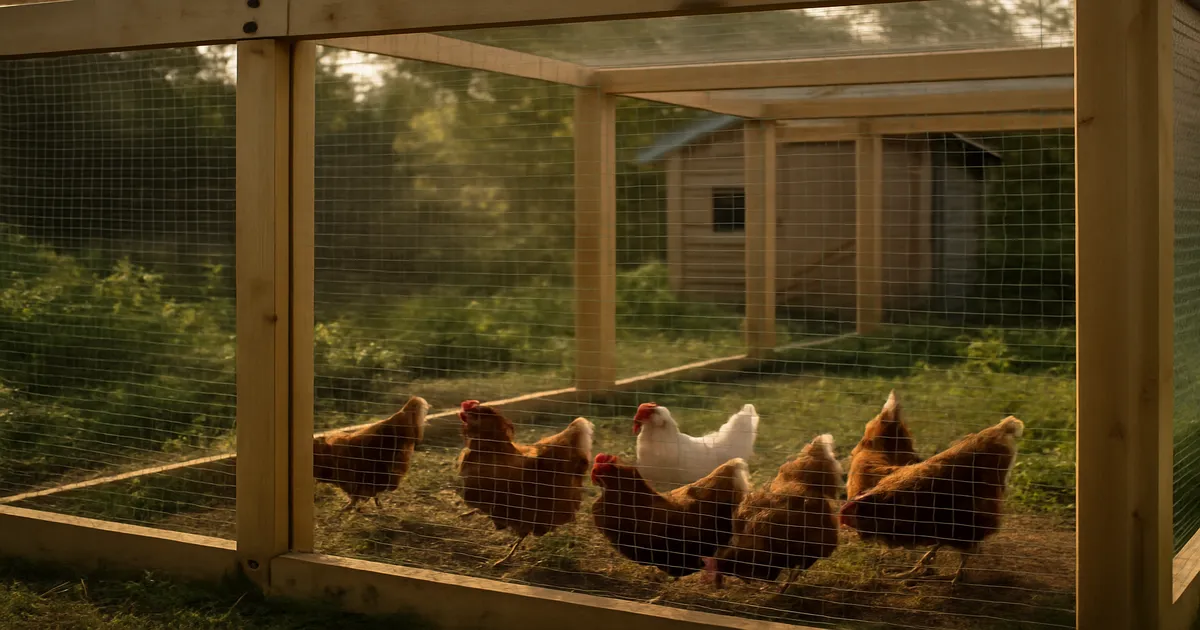
Quick Answer: To protect chickens from predators, build a secure coop using 19-gauge half-inch hardware cloth on every opening, install two-step latches, and add an apron or buried wire skirt around the perimeter. An automatic pop door and a strict nightly lock-up routine do more than almost any other single measure. No one fix is enough — lasting protection comes from layering multiple defenses together.
Predators kill more backyard chickens than disease, parasites, and every other cause combined. If you’re researching how to protect chickens from predators, here’s the honest truth: most losses are preventable. The harder truth is that predators are persistent, patient, and surprisingly good at finding the one gap you missed. This guide covers coop construction, run security, breed selection, guardian animals, and technology — so you can stop reacting to losses and start preventing them.
Know Your Enemy: Common Chicken Predators and Their Tactics
Understanding who you’re up against shapes every decision you make about housing and management.
Daytime Predators: Hawks, Foxes, and Dogs
Red-tailed hawks and Cooper’s hawks are the most common aerial threats, and they’re bold — they’ll strike in the open, in front of you, mid-afternoon. Bantams and small breeds are especially vulnerable because a Red-tailed hawk can carry prey weighing up to 4–5 lbs. Foxes are methodical; they probe fences, test gates, and dig. Domestic dogs are often underestimated, but a single dog can wipe out an entire flock in minutes.
Nighttime Predators: Raccoons, Opossums, Owls, and Weasels
Raccoons are the most dangerous nighttime predator for most backyard keepers — not because they’re the biggest, but because they’re the smartest. They can open simple hook-and-eye latches and sliding bolts with their hands. Weasels are terrifying for a different reason: they can squeeze through a gap as small as 1 inch and will kill every bird in the coop in a single visit.
How Predators Gain Entry
- Diggers: Foxes, coyotes, and dogs routinely tunnel under run walls
- Climbers: Raccoons scale chain-link and wooden fencing with ease
- Squeezers: Weasels, rats, and snakes exploit any gap larger than ½ inch
- Pullers: Raccoons reach through wire and drag birds toward the fence — standard chicken wire offers zero protection against this
How Predators Learn Your Flock’s Routine
This is the part most keepers overlook. Predators observe. A fox that watches your chickens gather near the coop door at dusk every evening will eventually be waiting there. Hawks identify the same open patch of yard where your hens dust-bathe every afternoon. Vary your routine where you can, and don’t let predictable behavior create predictable ambush points.
How to Predator-Proof Your Chicken Coop
Hardware Cloth vs. Chicken Wire: Why It Matters
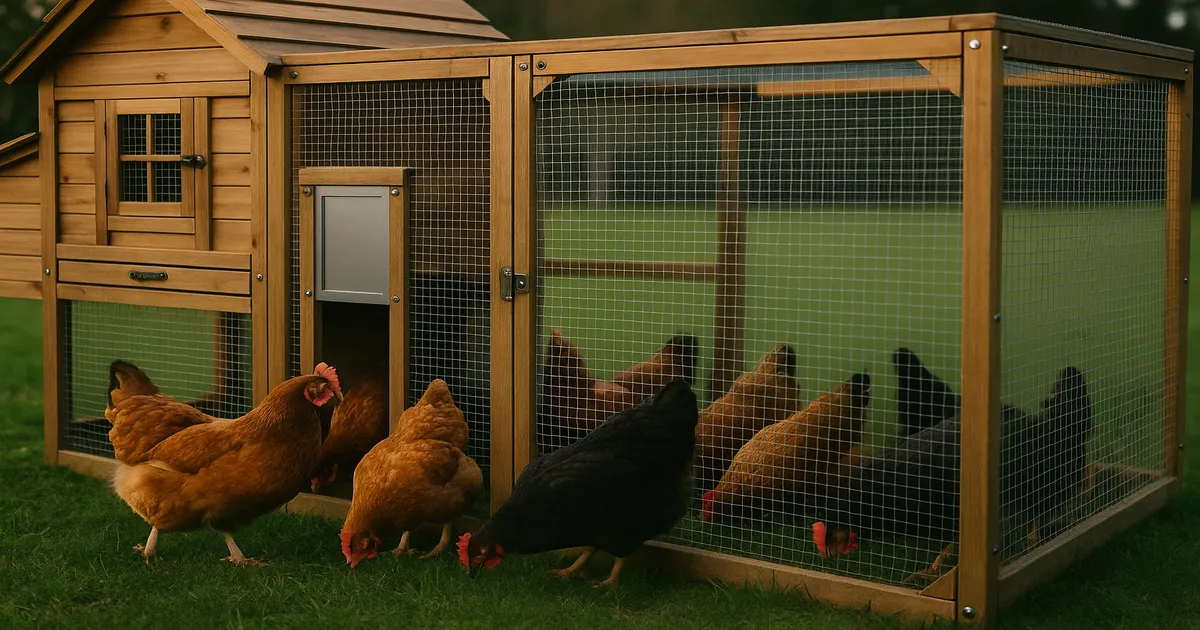
Chicken wire keeps chickens in. It does not keep predators out. The welded hexagonal mesh tears easily, the gaps are large enough for weasels, and a raccoon can rip it apart with its hands. 19-gauge half-inch hardware cloth is the minimum standard for every opening — vents, windows, pop door frames, and any gap larger than half an inch.
Floors, Foundations, and Digging Deterrents
A solid wood or concrete floor is your strongest option. If your coop sits on dirt, you have two good choices:
- Apron method: Lay hardware cloth horizontally outward from the base of the coop wall, extending 12 inches, and peg it to the ground. Diggers hit the wire before they reach the wall and typically give up.
- Buried skirt: Dig a trench 12–18 inches deep around the perimeter and bury hardware cloth vertically. More labor-intensive, but invisible and permanent.
Doors, Latches, and Pop Door Security
Standard latches are not enough. Raccoons figure out sliding bolts and hook-and-eye latches quickly — sometimes in a single night. Use two-step latches that require pressing and lifting simultaneously, or add a carabiner clip to any latch a raccoon could theoretically manipulate.
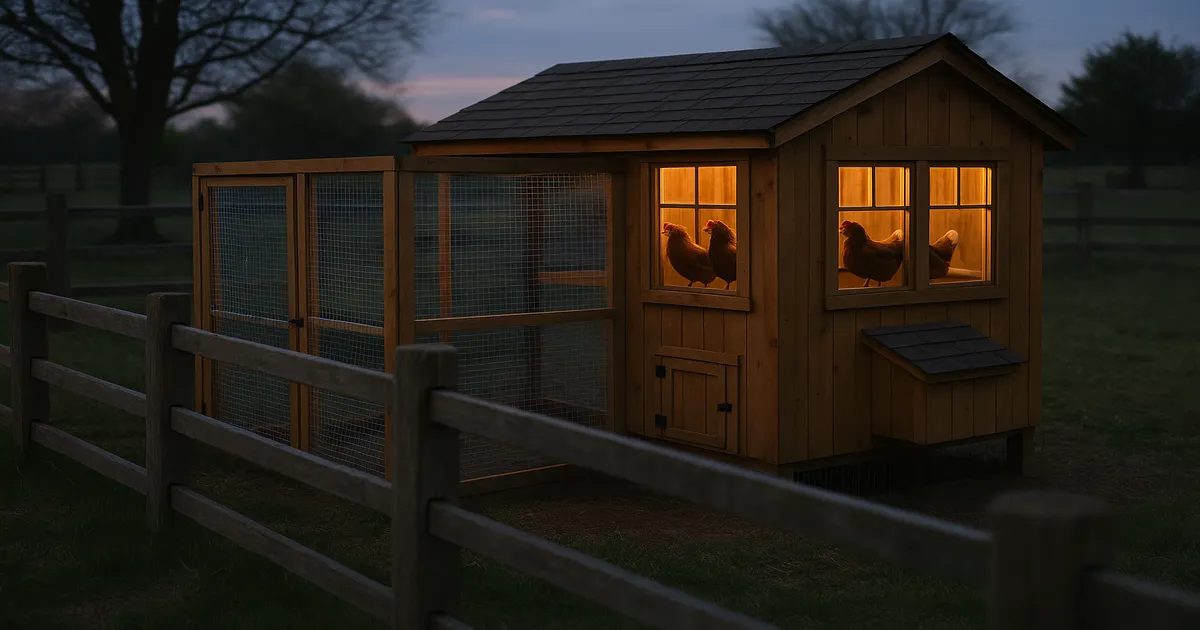
Your pop door — the small chicken-sized opening between the coop and run — should be 10–12 inches square for standard breeds. Keep it as small as functionally possible. An automatic pop door that closes at dusk (on a timer or light sensor) is one of the highest-impact upgrades you can make. Forgetting to close the coop at night is how most losses happen.
Ventilation That Keeps Predators Out
Your coop needs at least 1 square foot of vent opening per 10 square feet of floor space — more in hot climates. Position vents above roost height so cold drafts don’t blow directly on sleeping birds, and cover every vent with 19-gauge half-inch hardware cloth. No exceptions. A weasel doesn’t need much of an invitation.
Coop Elevation and Hiding Spot Elimination
Raising your coop 8–12 inches off the ground removes the shadowed hiding spots where predators crouch and wait. If you elevate more than 12 inches, enclose the underside with hardware cloth — otherwise you’ve just created a more sheltered hiding spot.
Seasonal Coop Inspections
Wood shrinks and warps with seasonal temperature swings, opening gaps that weren’t there six months ago. Walk the entire coop every spring and fall with a flashlight, checking corners, rooflines, and the base of walls. A predator will find what you miss.
Predator-Proofing Your Chicken Run
Fully Enclosed Runs: Roofs and Overhead Protection
An open-top run is an open invitation for hawks and owls. Bird netting is better than nothing — it slows aerial predators and makes them hesitant — but a full hardware cloth or welded wire roof is the only truly secure option. If you use bird netting, choose a heavy-gauge version and inspect it regularly for tears.
Apply the same apron or buried wire approach to your run perimeter. Most digging predators start right at the base of the fence and give up when they hit wire just 12 inches out.
Securing Feed to Avoid Attracting Predators
Open feeders left overnight are rodent magnets. Rodents attract snakes and weasels. Remove or secure feed every evening, and use hanging feeders positioned at back height — roughly 6–8 inches off the ground for standard hens. This reduces spilled grain and limits rodent access. Keep feeders and waterers away from fence lines, too — birds that congregate next to the fence to eat are within reach of anything that grabs through the wire.
Choosing Predator-Savvy Chicken Breeds
Breed choice won’t replace good housing, but it genuinely matters — especially for free-range flocks.
Breed Comparison: Predator Awareness
| Breed | Predator Awareness | Free-Range Suitability | Notes |
|---|---|---|---|
| Rhode Island Red | High | Excellent | Alert, quick to respond to threats |
| Barred Plymouth Rock | High | Excellent | Calm but vigilant |
| Australorp | High | Very Good | Active forager, aware of surroundings |
| Dominique | High | Excellent | Hardy, self-preserving heritage breed |
| Buckeye | High | Excellent | Active, good at evading ground predators |
| Leghorn | Medium-High | Good | Flighty but fast — hard to catch |
| Buff Orpington | Low | Moderate | Docile and slow; needs more structural protection |
| Silkie | Low | Poor | Crest restricts vision; easy target |
| Cochin | Low | Poor | Heavy, slow, and calm — very vulnerable |
| Brahma | Low | Poor | Large and slow; especially vulnerable at dusk |
Bantams and Aerial Predator Risk
Bantams are at elevated risk from hawks and owls simply because of their size. Most bantam breeds fall well within a Red-tailed hawk’s carrying range. If you keep bantams, a fully covered run or closely supervised free-ranging is non-negotiable.
Using Roosters and Guardian Animals for Flock Defense
How Roosters Protect the Flock
A good rooster does two things: he sounds the alarm and he acts on it. Roosters give distinct calls for aerial versus ground threats, and hens respond immediately — taking cover or freezing. A mature rooster will also physically engage small predators like weasels or young foxes. He won’t win against a coyote, but he buys the flock time. One rooster per 8–12 hens is the standard recommendation; more than that and you’ll see fighting and over-mating stress on hens.
Livestock Guardian Dogs
A well-trained Livestock Guardian Dog (LGD) is arguably the most effective predator deterrent available. Breeds like the Great Pyrenees and Anatolian Shepherd have been bred for centuries to bond with livestock and drive off threats. The critical word is trained — an LGD that hasn’t been raised with poultry from puppyhood can become a predator itself. Expect 12–18 months of supervised integration before the dog is reliably trustworthy with the flock.
Guinea Fowl and Geese
Guinea fowl are loud, alert, and genuinely effective as early-warning sentinels. They’ll raise the alarm for anything unusual — great for predator detection, occasionally exhausting for neighbors. Geese are more aggressive and will actively confront intruders. Both add management complexity, so weigh the tradeoffs honestly before adding them to your setup.
Free-Range Management: Letting Chickens Out Safely
Dawn and dusk are the highest-risk periods. Most predators — foxes, coyotes, hawks, raccoons — are most active in low light. If you can, let birds out a couple of hours after sunrise and bring them in an hour before sunset. Mid-morning to mid-afternoon is the safest window for unsupervised ranging.
Even your presence in the yard deters most predators. When you can’t supervise, a covered run is far safer than leaving birds fully exposed.
Dense shrubs, old pallets propped at an angle, and low shelters give chickens somewhere to dive when a hawk appears. Birds instinctively look for cover — spread those options across the ranging area, not just near the coop. Elderberry, forsythia, and similar dense plantings serve double duty: cover for the birds and a windbreak for the coop.
One more thing worth knowing: even a failed predator attack — one where no birds are lost — can suppress egg production for 3–7 days. A successful attack that kills even one flock member can suppress laying in survivors for up to two weeks. Predator prevention pays for itself in eggs alone, before you factor in the cost of replacing birds.
Technology and Additional Deterrents
Automatic Coop Doors
Timer-based models close at a set time each evening; light-sensor models close when ambient light drops below a threshold. Light-sensor models are generally more reliable across seasons since sunset shifts throughout the year. (Omlet Autodoor) Look for a motor strong enough to push through light debris and a safety sensor that prevents the door from closing on a bird.
Motion-Activated Lights and Sprinklers
Motion-activated lights startle nocturnal predators and make them feel exposed. They’re not foolproof — a determined raccoon will eventually ignore them — but they add a useful layer of deterrence, especially in the first weeks after installation. Motion-activated sprinklers work on the same principle and are particularly effective against foxes and coyotes. (Orbit 62100 Yard Enforcer)
Trail Cameras
If you’re losing birds and don’t know what’s responsible, a trail camera is your best diagnostic tool. Set it up near the coop or run entrance and check it after any incident. Knowing whether you’re dealing with a fox, raccoon, hawk, or neighbor’s dog determines exactly what countermeasures to deploy — and saves you from spending money on the wrong fix.
Frequently Asked Questions
What is the best predator-proof material for a chicken coop or run?
19-gauge half-inch hardware cloth is the gold standard. Unlike chicken wire, it can’t be torn by raccoons, is too small for weasels to squeeze through, and holds up to years of outdoor exposure. Use it on all vents, windows, run walls, and any gap larger than half an inch.
How do I stop foxes from digging under my chicken coop?
The apron method works reliably. Lay hardware cloth horizontally outward from the base of your coop or run wall, extending 12 inches, and peg it to the ground. Diggers hit the wire before they reach the wall and typically give up. For a permanent solution, bury wire 12–18 inches deep vertically around the perimeter.
Can a rooster really protect chickens from predators?
Yes — with realistic expectations. A rooster provides genuine early-warning calls for both aerial and ground threats, and a mature bird will physically engage small predators. He won’t stop a determined coyote or large dog, but he meaningfully reduces daytime losses and gives hens time to react.
What time of day are chickens most vulnerable?
Dawn and dusk are peak risk windows. Predators are most active in low light, and chickens are predictably vulnerable near the coop entrance at dusk when they’re congregating to roost. The safest free-range window is mid-morning to mid-afternoon.
How can I tell what predator is attacking my chickens?
Look at the evidence: entry point, what was taken, and how birds were killed. Raccoons often reach through wire and pull birds apart near the fence. Foxes typically carry birds away cleanly. Weasels kill multiple birds and may leave carcasses behind. Hawks leave a pile of feathers in an open area. A trail camera pointed at your coop overnight will give you a definitive answer.