Quick Answer: The best chicken breed for egg laying depends on your goals. For sheer volume, the White Leghorn leads with 280–320 eggs per year. For most backyard keepers, the Isa Brown or Rhode Island Red offers the best balance of output, temperament, and ease of care. Read on for a full breakdown of 10 top laying breeds ranked by real-world performance.
Choosing the best chicken breed for egg laying involves more than counting eggs. Climate, family situation, available space, and how long you want productive hens all play a role. This guide ranks and reviews the top 10 laying breeds so you can make the right call for your specific flock — not just pick the highest number on a chart.
Best Chicken Breeds for Egg Laying at a Glance
Top Pick for Maximum Production: White Leghorn
If eggs per year is your only metric, the White Leghorn wins — consistently. Expect 280–320 eggs per year from a healthy hen, with commercial lines sometimes pushing higher. They’re efficient, relentless, and don’t waste calories growing a large body. The trade-off is temperament: Leghorns are flighty and independent, not the friendliest birds in the yard.
Top Pick for Beginners: Rhode Island Red or Isa Brown
Rhode Island Reds are forgiving, hardy, and dependable — a great first breed that lays 250–300 brown eggs per year. The Isa Brown edges them out on raw numbers (300–350 eggs/year) and is arguably the most docile production bird available, but comes with reproductive health caveats after Year 3.
Top Pick for Family Flocks: Buff Orpington or Easter Egger
Neither will break egg records, but both are genuinely enjoyable to keep. Buff Orpingtons are calm enough for young children to handle. Easter Eggers bring personality and colorful blue, green, and pink eggs that make every basket a conversation starter.
Full Breed Comparison Table
| Breed | Eggs/Week | Eggs/Year | Egg Color | Egg Size | Laying Onset | Broody? |
|---|---|---|---|---|---|---|
| White Leghorn | 5–7 | 280–320 | White | Large–XL | 16–18 wks | Rarely |
| Isa Brown | 6–7 | 300–350 | Brown | Large–XL | 16–18 wks | Rarely |
| Rhode Island Red | 5–6 | 250–300 | Brown | Large | 18–20 wks | Rarely |
| Australorp | 5–6 | 250–300 | Light Brown | Large | 22–24 wks | Rarely |
| Barred Rock | 4–5 | 200–280 | Brown | Large | 18–20 wks | Occasionally |
| Easter Egger | 4–5 | 200–280 | Blue/Green/Pink | Med–Large | 20–24 wks | Occasionally |
| Sussex | 4–5 | 200–250 | Light Brown | Large | 20–22 wks | Occasionally |
| Wyandotte | 3–4 | 180–220 | Brown | Large | 20–24 wks | Occasionally |
| Buff Orpington | 3–5 | 175–200 | Light Brown | Large | 20–24 wks | Frequently |
| Black Copper Marans | 3–4 | 150–200 | Dark Chocolate Brown | Large | 24–28 wks | Occasionally |
How We Ranked the Best Egg-Laying Chicken Breeds
Annual egg count is the primary ranking factor, but consistency across seasons matters just as much as peak numbers. A breed that reliably lays 280 eggs beats one that peaks at 320 and then drops sharply in cold weather or after Year 2.
Temperament matters too. A high-strung bird that’s difficult to handle isn’t a good fit for most backyard keepers, especially beginners. Beyond that, comb type, body size, and feather density all affect how well a breed handles temperature extremes — a Wyandotte’s rose comb is far less frostbite-prone than a Leghorn’s large single comb, and that difference is very real if you’re keeping chickens in the northern US.
Heritage breeds vs. production hybrids is the trade-off most new keepers don’t hear about until it’s too late. Production hybrids like the Isa Brown are engineered for maximum output — 300–350 eggs in Year 1 is genuinely impressive. But that biological intensity takes a toll. By Year 3–4, many hens experience reproductive issues like egg yolk peritonitis or internal laying, which can be fatal. Heritage breeds — Rhode Island Reds, Australorps, Barred Rocks — lay fewer eggs at peak but stay productive for 5–7 years with far fewer health complications. If you’re planning a long-term flock, that longevity often wins on total lifetime egg count.
Top 10 Egg-Laying Chicken Breeds Reviewed
1. White Leghorn: The Egg-Laying Champion
Developed in Tuscany and imported to the US in the 1850s, the White Leghorn became the backbone of the commercial egg industry for a reason. At 280–320 white, large-to-extra-large eggs per year, no heritage breed touches them for sheer output. They start laying early — often by 16–18 weeks — and rarely go broody.
The downsides are real. Leghorns are active, flighty, and easily startled. They’re not lap birds. That large single comb is also prone to frostbite in northern winters, so cold-climate keepers should apply a thin layer of petroleum jelly to the comb during cold snaps or choose a more cold-hardy breed. Best for: keepers who want maximum eggs and don’t need a friendly pet.
2. Isa Brown: Best Production Hybrid for Backyard Keepers
Developed in France in the 1970s as a commercial brown-egg machine, the Isa Brown delivers — 300–350 eggs per year, early onset at 16–18 weeks, and a temperament that’s surprisingly sweet for such a productive bird. They’re sex-linked, meaning males hatch white and females hatch brown, which makes ordering pullets from a hatchery straightforward.
The caveat is worth repeating: Isa Browns are prone to reproductive health issues by Year 3–4. If you’re comfortable cycling birds on a 2–3 year schedule, they’re arguably the best backyard layer available. If you want a flock that lives 6–8 years, look elsewhere.
3. Rhode Island Red: The Reliable All-Rounder
The Rhode Island Red has been a staple of American backyard flocks since the 1880s, and it’s earned that reputation. Expect 250–300 brown eggs per year, a hardy constitution, and a bird that handles both cold winters and beginner mistakes with minimal drama. Hens are generally calm and manageable, though roosters can be assertive.
One nuance worth knowing: “Production Reds” sold by most hatcheries are lighter in color and higher-producing than true Heritage Reds, which are darker, slower-maturing, and slightly lower in output. Either works well for backyard keeping.
4. Australorp: Record-Breaking Layer With a Gentle Nature
Developed in Australia from Black Orpington stock, the Australorp set a world record in 1922–1923 trials: 364 eggs in 365 days from a single hen. Modern Australorps won’t quite hit that mark, but 250–300 eggs per year from a calm, quiet bird that adapts equally well to confinement or free-ranging is genuinely excellent.
Their glossy black plumage with a green iridescent sheen is striking. They’re one of the gentler large breeds available and cold-hardy to around 0°F (-18°C) with proper housing — a strong choice for northern keepers who want both production and a pleasant flock experience.
5. Barred Rock: Hardy, Friendly, and Consistent
The Barred Rock’s distinctive black-and-white striped pattern is one of the most recognizable sights in American backyard flocks. First exhibited in Boston in 1849, these birds combine reliable production (200–280 eggs/year) with a calm temperament that tolerates handling well. They’re dual-purpose, cold-hardy, and rarely go broody. Not the flashiest choice, but consistently one of the most practical.
6. Sussex: Year-Round Layer With Old-World Charm
The Sussex — particularly the Speckled variety with its distinctive white-tipped feathers — is one of England’s oldest breeds and a genuinely underrated layer. At 200–250 eggs per year, production is solid rather than spectacular, but Sussex hens tend to keep laying through winter better than many breeds. That’s a real advantage if you’re skipping supplemental lighting. They’re calm, curious, and handle both confinement and free-ranging well.
7. Easter Egger: Colorful Eggs and a Crowd-Pleasing Personality
Easter Eggers aren’t a true breed — they’re mixed-heritage birds carrying the blue-egg gene from Araucana or Ameraucana genetics. What you get is a variable, personable bird that lays blue, green, or occasionally pink eggs and produces 200–280 per year. No two Easter Eggers look exactly alike, which adds to their charm. They have pea combs that resist frostbite, handle heat reasonably well, and are genuinely among the friendliest birds you can keep.
8. Wyandotte: Cold-Hardy Beauty With Solid Production
Developed in the northeastern US in the 1870s, Wyandottes have a rose comb that makes them exceptionally cold-hardy — one of the best choices for keepers in harsh winter climates. Silver-Laced and Gold-Laced varieties are among the most visually striking birds in any backyard flock. Production sits at 180–220 brown eggs per year, which is moderate. They can be a bit bossy in mixed flocks but are otherwise manageable.
9. Buff Orpington: The Family Favorite
If you want chickens your kids can carry around without drama, the Buff Orpington is the answer. These large, fluffy golden birds are famously docile — calm enough to be handled by young children and patient enough to tolerate beginners. They’re cold-hardy to 0°F (-18°C) and dual-purpose, with enough meat on them to be practical if you ever need to cull the flock.
The trade-off is production. At 175–200 light-brown eggs per year, they’re the lowest-output standard layer on this list, and they go broody frequently — a broody hen stops laying entirely for 3–8 weeks at a stretch. If eggs are your primary goal, pair a few Buff Orpingtons with higher-producing breeds.
10. Black Copper Marans: Specialty Dark Eggs Worth the Wait
Black Copper Marans lay the darkest eggs of any breed on this list — a deep chocolate brown that looks almost painted. They’re the breed behind the famous “chocolate egg” reputation in French cuisine and have developed a devoted following among specialty egg keepers and chefs. Production is the lowest here: 150–200 eggs per year, with laying not starting until 24–28 weeks. For most keepers, a few Black Copper Marans mixed into a flock of higher producers creates a visually stunning egg basket without sacrificing too much overall output.
What Affects How Many Eggs Your Hens Lay
Daylight, Molting, and the Laying Cycle
Hens need roughly 14 hours of daylight to maintain consistent egg production. When days shorten below that threshold — typically October through February across most of the US — the pineal gland reduces reproductive hormone production and laying slows or stops. This is completely normal.
Every fall, hens also go through an annual molt, shedding old feathers and regrowing new ones over 6–12 weeks. Egg production halts entirely during this time. The upside: post-molt eggs often have noticeably better shell quality as the hen’s system resets.
Adding supplemental light to bring total daily exposure to 14–16 hours will keep most hens laying through winter. A simple timer on a low-wattage LED bulb works well — add light in the early morning rather than the evening so hens still go to roost naturally at dusk. That said, giving hens a natural winter break does reduce long-term reproductive stress, so it’s a genuine trade-off.
Peak Laying Years and Decline
Most hens hit peak production in Years 1 and 2, then decline roughly 15–20% per year from there. A hen laying 280 eggs in Year 1 might lay around 230 in Year 3 and 180 in Year 5. Heritage breeds decline more gradually; production hybrids often drop more sharply. Calcium depletion compounds the issue in older hens — shells can become thinner and more fragile over time. Offering free-choice oyster shell from first lay onward helps offset this. A hanging feeder filled with crushed oyster shell keeps it accessible without mixing it into the main feed.
Broodiness
A broody hen is convinced she’s going to hatch eggs — with or without a rooster. She’ll sit in the nesting box, refuse to leave, and stop laying entirely for the 3-week incubation period plus recovery, totaling 3–8 weeks of zero production. Buff Orpingtons are notorious for this. To break a broody hen early, move her to a wire-bottomed broody-breaking cage for a few days — the airflow underneath disrupts the hormonal cycle that drives broodiness.
Coop and Housing Requirements for Laying Hens
Space, Roosts, and Nesting Boxes
The minimum is 4 sq ft per bird inside the coop and 10 sq ft per bird in the run. Crowding above those thresholds causes feather pecking, elevated stress hormones, and measurably reduced egg production. If you can build bigger, aim for 6–8 sq ft inside and 15–20 sq ft in the run. Free-ranging hens ideally have 250+ sq ft per bird to roam.
For roost bars, allow 8–12 inches of linear space per bird (12 inches for large breeds), set 18–36 inches off the ground. Keep heavier breeds like Buff Orpingtons and Australorps on the lower end to protect their joints on dismount. Use 2–4 inch flat or slightly rounded bars — narrow dowels cause foot fatigue, and metal bars risk cold injury in winter.
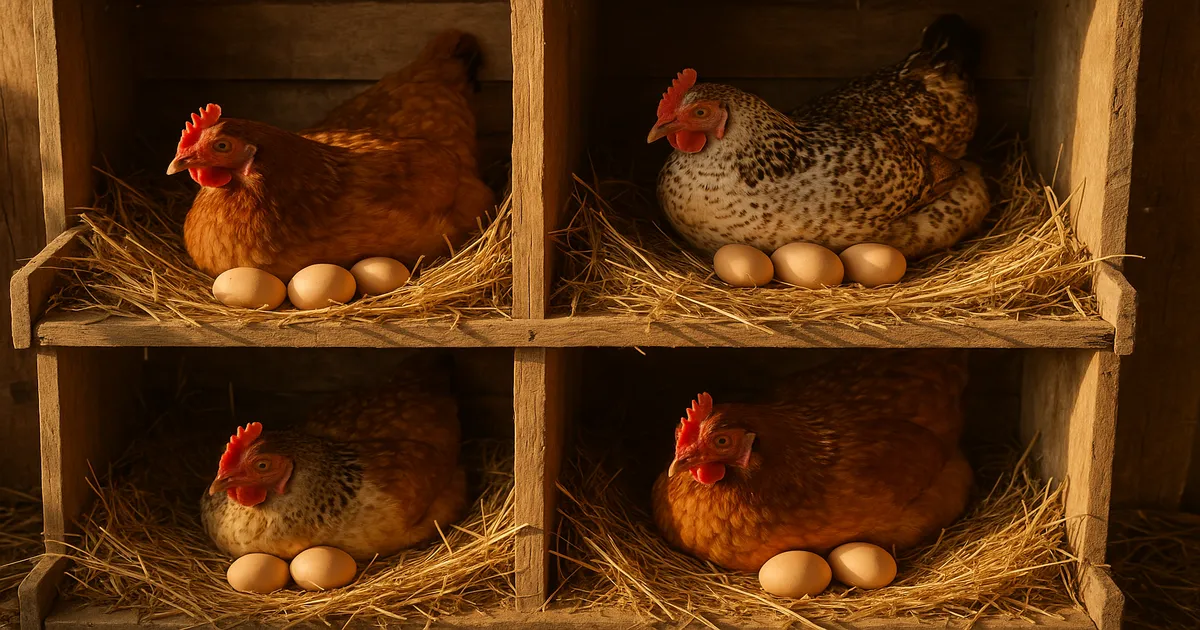
One nesting box per 4–5 hens is the standard ratio. Minimum dimensions are 12×12×12 inches for standard breeds; bump to 14×14×14 for large breeds. Position boxes 12–18 inches off the floor and always lower than the roost bars, or hens will sleep in them and soil the eggs. Keep 3–4 inches of pine shavings or straw in each box. Rollaway nesting boxes are excellent for preventing egg eating, since the egg rolls immediately to a collection tray before a hen can peck at it.
Ventilation and Cold-Weather Management
Provide at least 1 sq ft of ventilation per 10 sq ft of coop floor space, positioned near the roofline so moisture and ammonia escape without creating drafts at bird level. If your eyes water when you enter the coop, ammonia has exceeded safe levels — the threshold for respiratory damage in chickens is around 25 ppm. A damp coop is more dangerous than a cold one; moisture drives frostbite and respiratory illness far more than temperature alone.
Wyandottes, Barred Rocks, Australorps, and Buff Orpingtons are all hardy to 0°F (-18°C) with proper housing. Leghorns can handle cold down to about 20°F (-7°C), but their large single combs are frostbite-prone. Supplemental heat is generally unnecessary and adds fire risk. If you do need it, flat-panel radiant heaters are a much safer option than heat lamps.
Predator-Proofing
- Bury a 12-inch hardware cloth apron around the coop perimeter to stop diggers
- Use carabiner clips or two-step latches — raccoons can open simple hook-and-eye latches
- Install an automatic pop door with a light sensor or timer for consistent nighttime security
- Seal any gap larger than ½ inch — weasels are smaller than most people expect
Feeding Laying Hens for Maximum Egg Production
Layer feed should contain 15–18% protein and 3.5–4.5% calcium to support consistent shell quality. Switch pullets from grower feed (18–20% protein, low calcium) to layer feed when they reach 18–20 weeks or lay their first egg — whichever comes first. Feeding high-calcium layer feed to young pullets before their kidneys are mature enough to process it can cause long-term kidney damage, so timing matters.
A standard laying hen eats roughly ¼ lb (about ½ cup) of feed per day. Free-ranging hens will supplement with insects and greens, but shouldn’t be expected to meet their full nutritional needs from forage alone. A quality pellet or crumble (Purina Layena Plus Omega-3 Layer Pellets) fed free-choice is the simplest way to ensure consistent nutrition year-round.
Always provide fresh water — a hen that runs out of water for even a few hours can stop laying for days. Heated waterers prevent freezing in winter and remove one of the most common causes of winter production drops.
Frequently Asked Questions
What is the best chicken breed for egg laying overall? The White Leghorn lays the most eggs — 280–320 per year — but the Isa Brown or Rhode Island Red is a better fit for most backyard keepers because of their calmer temperament and greater hardiness.
How many eggs per year can I realistically expect from backyard hens? Most backyard hens in their first two years lay 200–300 eggs per year, depending on breed, management, and season. Production drops 15–20% annually after peak.
Do I need a rooster for my hens to lay eggs? No. Hens lay eggs without a rooster. You only need a rooster if you want fertilized eggs to hatch chicks.
Which chicken breed is best for cold climates? Wyandottes, Australorps, Barred Rocks, and Buff Orpingtons are all excellent cold-weather breeds. Their rose or pea combs and dense plumage make them far more frostbite-resistant than single-combed breeds like the Leghorn.
How long do laying hens stay productive? Most hens lay well for 2–3 years. Heritage breeds can remain productive at lower rates for 5–7 years. Production hybrids like the Isa Brown often experience health issues after Year 3 that shorten their productive lifespan.