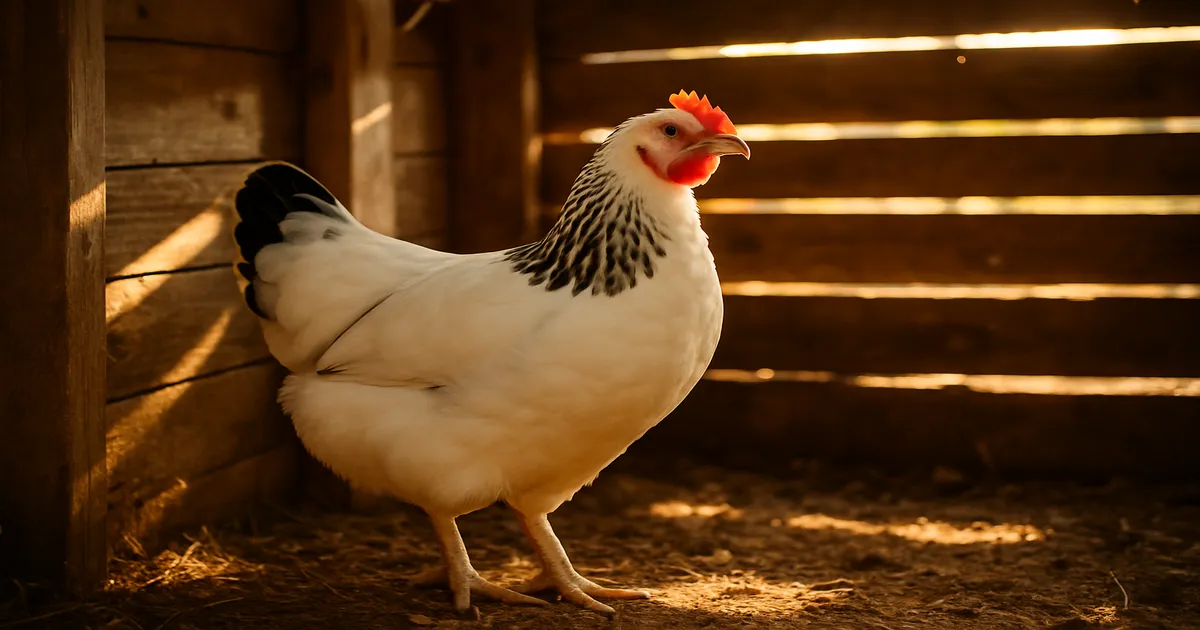
Quick Answer: At 20 weeks, sexing a Light Sussex is straightforward. A cockerel will have a large, bright-red comb, pointed hackle and saddle feathers, and noticeably thicker legs. A pullet will have a smaller, paler comb, rounded hackle feathers, and no saddle feathers — and she may be just days away from her first egg.
If you’re asking “Light Sussex about 20 weeks — pullet or cockerel?” you’re in luck. By this age, the guesswork is essentially over. Light Sussex show clear, reliable physical differences between the sexes at 20 weeks, and once you know what to look for, the answer usually takes about five minutes of observation.
This guide walks you through every visual and behavioural clue. It also covers what comes next — whether you’re preparing for your first egg or figuring out what to do with a surprise cockerel.
Is My Light Sussex a Pullet or Cockerel at 20 Weeks?
The Three Fastest Visual Checks
Start here before examining anything else:
- Comb and wattles — A cockerel’s comb is significantly larger, taller, and brighter red by 20 weeks. A pullet’s comb is smaller and pinker, though it will be reddening if she’s close to laying.
- Hackle and saddle feathers — Look along the neck and lower back. Pointed, glossy, flowing feathers mean cockerel. Rounded, neat feathers mean pullet.
- Body size and leg thickness — Cockerels are taller, broader in the shoulder, and have noticeably thicker shanks. Stand them side by side if you can.
Why 20 Weeks Is a Reliable Sexing Window
Uncertainty before 12 weeks is completely normal with Light Sussex — the breed doesn’t show strong early dimorphism. By 16–20 weeks, testosterone-driven development has produced unmistakable changes in cockerels. The saddle feathers alone are essentially definitive: long, pointed feathers fanning out over the lower back toward the tail mean that bird is a cockerel. Full stop.
Understanding the Light Sussex Breed
Breed Origin and Dual-Purpose Heritage
The Light Sussex is one of England’s oldest and most celebrated breeds, originating in Sussex and formally standardised by the Sussex Breed Club around 1903. Recognised by both the American Poultry Association and the Poultry Club of Great Britain, it was bred as a true dual-purpose bird — valued equally for table qualities and steady egg production. Eight varieties are recognised (Light, Red, Speckled, Brown, Buff, Silver, White, and Coronation), but the Light is by far the most widely kept worldwide.
Standard Appearance
The Light Sussex has a large, rectangular frame with a broad chest, flat back, and well-muscled thighs. Plumage is distinctive: a clean white body with black-laced hackle feathers around the neck, black primary wing feathers, and a black tail with white lacing. Hens typically weigh 7–8 lbs (3.2–3.6 kg); roosters reach 9–10 lbs (4.1–4.5 kg). Both sexes have a single red comb, white or pinkish-white clean legs, and orange-red eyes.
Temperament
Light Sussex pullets are calm, curious, and genuinely friendly. Many will follow their keeper around the yard and tolerate handling without fuss — ideal for families and beginners. Cockerels are generally less aggressive than many other breeds, but they’re still more assertive than hens. Expect upright, watchful posture, territorial behaviour toward other males, and increasing confidence as testosterone peaks between 5 and 9 months.
How to Tell a Light Sussex Pullet from a Cockerel at 20 Weeks
Comb and Wattle Development
This is the first thing most people notice. By 20 weeks, a cockerel’s single comb is large, upright, and a deep vivid red — with five distinct points clearly defined. His wattles are similarly enlarged and bright. A pullet’s comb is considerably smaller and paler, sitting closer to the head. It may show a slight lop to one side, which is normal in females of this breed. If she’s approaching her first lay, her comb will be reddening and growing, but it still won’t match a cockerel’s.
Hackle Feathers: Rounded vs. Pointed
Hackle feathers grow around the neck and drape down over the shoulders. On a cockerel, they are long, narrow, pointed at the tip, and have a distinct glossy sheen — almost metallic in sunlight. On a pullet, hackle feathers are shorter and clearly rounded at the tip, with no special sheen. Pick up a single feather and look at the end: that shape tells you a lot.
Saddle Feathers: The Cockerel’s Giveaway
The saddle is the lower back, just before the tail. In a cockerel, long, flowing, pointed feathers develop here by 16–20 weeks, fanning outward and downward in a distinctive cascade. Pullets have no saddle feathers — the feathering across their lower back is short, rounded, and unremarkable. If you’re ever unsure about comb development, the saddle is your tiebreaker.
Tail Feathers and Sickle Feathers
Cockerels develop long, curved sickle feathers in the tail — the arching feathers that give a rooster’s tail its characteristic shape. At 20 weeks they may still be growing in, but you should already see the beginnings of that upward curve. Pullet tails are neat, shorter, and fan-shaped with no dramatic curves.
Body Size and Leg Thickness
Stand back and look at the overall silhouette. Cockerels are taller, broader across the shoulders, and carry themselves more upright. Their shanks — the lower leg between the foot and the hock — are noticeably thicker than a pullet’s of the same age. At 20 weeks, a cockerel may already be approaching the 7–8 lb range, while pullets typically lag behind by a pound or two.
Behavioural Clues That Confirm Sex
Cockerel Behaviours to Watch For
Physical signs are usually enough, but behaviour makes it airtight. Look for:
- Crowing attempts — even if it sounds like a strangled squeak at first, it’s crowing
- Tidbitting — calling flock members over to food with rapid clucking and head-bobbing
- Chest-bumping — squaring up to other birds, especially other young males
- Early mounting attempts — awkward and brief at this age, but present
- Sentinel posture — standing tall at the flock perimeter, head up, scanning for threats
Pullet Pre-Laying Behaviours
A pullet approaching her first lay gives clear signals. The most reliable is the submissive squat: when you reach toward her, she crouches low and spreads her wings slightly. This is her instinct to accept a rooster, and it means she’s hormonally ready to lay. You’ll also notice her spending more time investigating the nest boxes, and her appetite may increase noticeably.
Flock Dynamics as a Sexing Aid
Watch where each bird positions itself in the flock. Cockerels naturally drift to the edges, keeping watch — it’s instinctive sentinel behaviour. Pullets integrate more quietly, moving with the flock rather than patrolling the perimeter. If one bird consistently stands apart and watches, that’s almost always your cockerel.
What Comes Next: Pullet Milestones After 20 Weeks
When Will Your Light Sussex Pullet Lay Her First Egg?
Light Sussex pullets typically lay their first egg between 20 and 24 weeks. If your pullet is exactly 20 weeks old and showing a bright red comb, squatting behaviour, and interest in the nest boxes, she could be days away. Don’t be alarmed if the first few eggs are small, misshapen, or occasionally shell-less — this is completely normal for the first 4–6 weeks of laying as her system gets into rhythm.
What Do Light Sussex Eggs Look Like?
Light Sussex hens lay large to extra-large eggs with a light brown or tinted (sometimes almost cream) shell. At full maturity, expect eggs in the 60–70g range. Production runs at around 4–5 eggs per week — roughly 200–260 eggs per year at peak. Like all hens, production is highest in years one and two, then declines by roughly 15–20% per year after that.
Switching to Layer Feed at 18–20 Weeks
Move your pullets from grower feed to a layer pellet with 15–17% protein and around 3.5–4% calcium at 18–20 weeks. Pellets are preferable to mash for large breeds — less waste, less mess. If you’re not sure she’s started laying yet, you can keep her on grower feed and offer free-choice oyster shell separately; hens self-regulate their calcium intake and won’t overconsume. A good option here is Manna Pro Oyster Shell , which is widely available and easy to dispense in a small hanging cup. Once you see that first egg, the switch to layer feed is confirmed.
For feeders, a large-capacity hanging feeder keeps feed off the ground and reduces waste with big birds like Light Sussex.
Managing a Confirmed Cockerel
Keeping a Light Sussex Cockerel: Pros and Cons
Light Sussex cockerels are genuinely among the more manageable roosters you can keep. They’re not known for aggression toward humans, and they’re excellent at protecting the flock. If you want to hatch fertile eggs, you need one. The downsides are real, though. Crowing starts early and happens often — not just at dawn. Feed costs increase. And as testosterone peaks between 5 and 9 months, even a gentle cockerel can become rough on pullets. Aim for no more than one cockerel per 8–12 hens to prevent over-mating stress.
Legal and Neighbour Considerations
Many urban and suburban areas prohibit roosters outright, and some rural areas have noise ordinances that effectively ban them. Check your local bylaws before you commit to keeping him. A surprise complaint from a neighbour is a much harder situation to navigate than planning ahead.
Rehoming, Selling, or Processing
If keeping isn’t an option, you have several practical routes:
- Rehoming: Local poultry Facebook groups, Craigslist, and breed clubs often have people actively looking for Light Sussex cockerels
- Selling: Young Light Sussex cockerels from good stock can fetch a fair price — list him with a photo and his age
- Processing: Light Sussex have genuine dual-purpose heritage, and a 20-week cockerel will dress out respectably. This is a legitimate and traditional option that many keepers choose without apology
Housing and Care at 20 Weeks
Space Requirements
Light Sussex are big birds and need proportionally more space than bantams or lighter breeds. Allow a minimum of 4 sq ft per bird inside the coop — 6–8 sq ft is strongly recommended. In the run, aim for at least 10 sq ft per bird. Crowding causes feather pecking, stress, and disease, and it’s almost always the root cause when flock problems develop.
Roost Bar Setup
Use 2×4 lumber laid flat (wide face up) rather than round dowels or PVC. The flat surface lets Light Sussex spread their toes comfortably and cover their feet with their breast feathers on cold nights, which helps prevent frostbite. Mount roost bars at 18–24 inches off the floor — high enough to feel safe, low enough that heavy birds don’t injure themselves landing. Allow 14–16 linear inches per bird.
Nest Box Readiness
If your pullets are 20 weeks old, your nest boxes need to be ready now. Use 14×14 inch boxes — standard 12-inch boxes are tight for Light Sussex hens. One box per 4–5 hens is sufficient (they’ll share favourites regardless). Mount them lower than the roost bars to discourage sleeping in the boxes, and fill them with 3–4 inches of pine shavings.
Ventilation, Cold Hardiness, and Predator-Proofing
High vents in the eaves or upper walls are essential — moisture and ammonia are far more dangerous to your flock than cold air. Never seal the coop completely in winter. If you can smell ammonia when you walk in, ventilation is inadequate.
Light Sussex are a cold-hardy breed and handle winter well. Their single combs, however, can be susceptible to frostbite in extreme cold. A thin layer of petroleum jelly on the comb during a hard freeze offers simple, effective protection.
For predator-proofing: use a hardware cloth apron extending 12–18 inches outward from the coop walls, fit two-step latches on all doors, and seal any gaps larger than half an inch. Raccoons are persistent, and weasels can squeeze through surprisingly small openings. An automatic coop door adds a reliable layer of protection at dusk and dawn.
Feeding Your Flock at the 20-Week Mark
Oyster Shell and Grit
Always offer oyster shell free-choice in a separate dish — never mixed into feed. A laying hen needs around 4 grams of calcium per day for proper eggshell formation, and she’ll take what she needs. Offer insoluble granite grit separately for any birds eating scratch, treats, or free-ranging. Don’t confuse the two: oyster shell dissolves and provides calcium; grit stays in the gizzard and grinds food.
Daily Feed Amounts
Light Sussex eat toward the higher end of the spectrum — plan for 4–6 oz (115–170g) of feed per bird per day. Free-choice feeding works well for backyard flocks; just keep feeders clean and topped up. Fresh water is non-negotiable. Hens drink 0.5–1 pint (250–500ml) per day, and egg production drops rapidly if water is restricted even briefly.