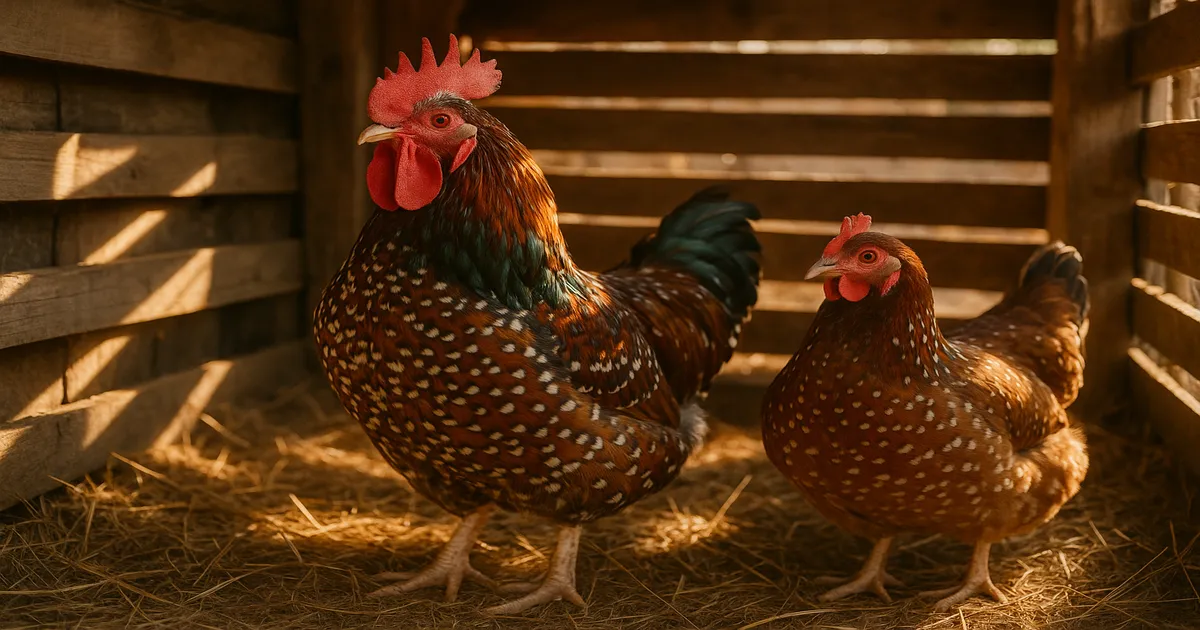
Quick Answer: The fastest way to tell a Speckled Sussex rooster from a hen is to look at three things: comb size, tail feathers, and saddle feathers. Roosters have a large, bold single comb, long pointed saddle feathers over their lower back, and sweeping sickle tail feathers held at a steep 70–80° angle. Hens are smaller, rounder, and have a modest comb with no saddle feathers and a tail carried at a gentler 45°.
If you’ve just picked up a straight-run batch of chicks, figuring out who’s who can feel surprisingly tricky — especially in the first few weeks when everyone looks nearly identical. Understanding the speckled sussex rooster vs hen differences will save you from a few surprises come crowing time. The good news: by 8–10 weeks, several reliable clues are already visible.
Speckled Sussex Rooster vs Hen: How to Tell Them Apart
Comb, Wattles, and Facial Features
A rooster’s comb is hard to miss once it comes in — large, bright red, and upright with five to six defined points. His wattles are long and pendulous, swinging noticeably when he moves. Hens have a single comb too, but it’s smaller, less vivid, and sits more neatly on the head. Side by side, the difference is obvious. On a single bird, it helps to know what “normal” looks like for the breed.
Hackle, Saddle, and Tail Feathers
Feather shape is one of the most reliable sexing tools once birds are past the chick stage. Rooster hackle feathers are long and pointed, flowing over the shoulders in a cape-like drape. Saddle feathers — the long, pointed feathers that fan out over the lower back and rump — are exclusive to roosters. Hen back feathers are rounded and lie flat.
The tail tells the story too. A rooster’s sickle feathers curve dramatically upward at 70–80°, giving him that classic proud silhouette. A hen’s tail is moderate in size and sits at a relaxed 45°.
Body Shape, Weight, and Spurs
Standard Speckled Sussex roosters weigh around 9 lbs (4.1 kg); hens come in at 7 lbs (3.2 kg). Beyond weight, their body shapes differ noticeably. Roosters carry themselves upright with broad, rectangular shoulders. Hens are rounder and more horizontal, with a deeper keel that reflects their egg-laying anatomy.
Spur development begins around 4–6 months in roosters and can reach 1–2 inches by the second year. Hens either have no spurs or small vestigial bumps — nothing you’d confuse with a rooster’s spur.
Bantam Speckled Sussex follow the same visual rules at a smaller scale: roosters around 30 oz (850 g) and hens around 26 oz (740 g).
The Speckled Feather Pattern — What Both Sexes Share
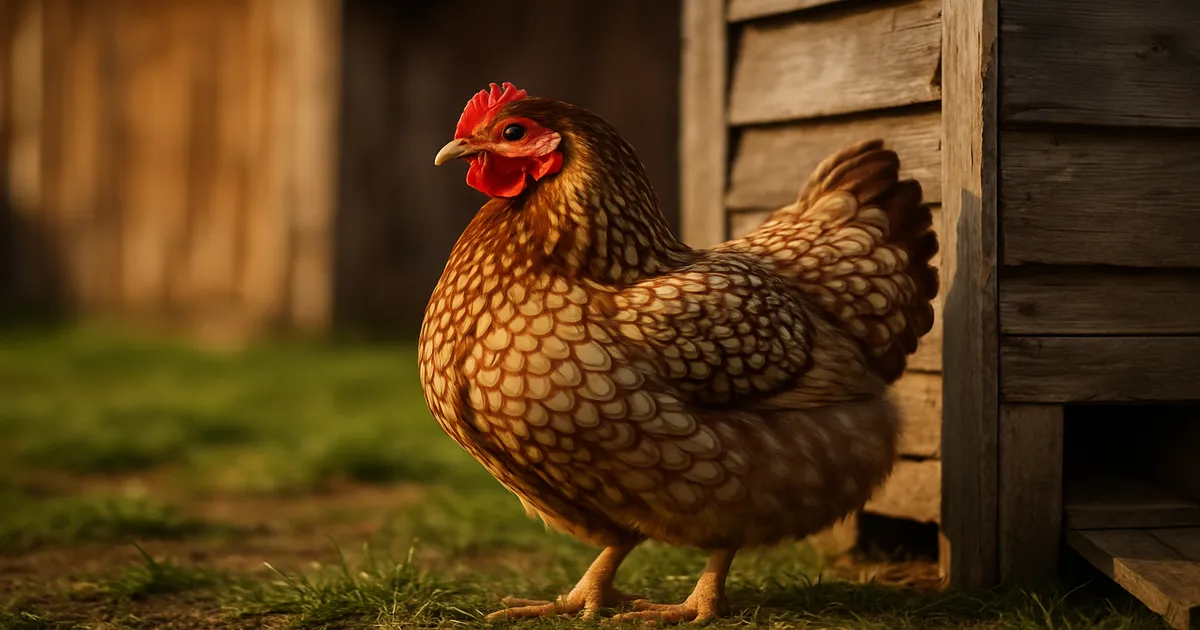
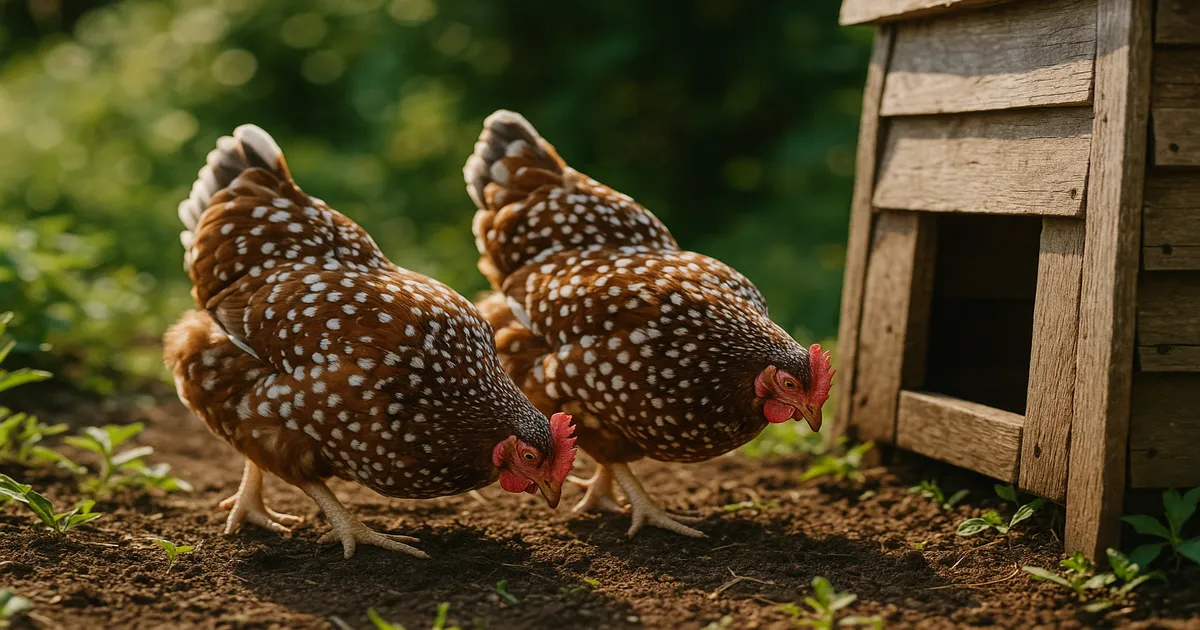
Both sexes carry the breed’s signature tri-color plumage: rich mahogany brown feathers, each tipped with a black bar and then a white spangle at the very tip. This layered pattern is what creates the “speckled” effect the breed is named for. Hens tend to show the pattern more densely; roosters may appear slightly less heavily speckled. Either way, both are striking birds.
Here’s a fun quirk unique to this breed: after each annual molt, Speckled Sussex gain more white speckles. A three-year-old hen looks noticeably more heavily speckled than a pullet in her first year. This happens in both sexes, so a densely speckled older bird isn’t a different variety — she’s just been through a few molts.
Temperament: Rooster vs Hen Personality Differences
How Speckled Sussex Hens Behave
Speckled Sussex hens have a well-earned reputation as “lap chickens.” They’re curious, calm, and genuinely people-oriented — often following their keepers around the yard and tolerating handling better than most breeds. That makes them an excellent choice for families with children. Aggression toward flock mates is rare; they tend to sit comfortably in the middle of the pecking order, neither bully nor victim.
What to Expect from a Speckled Sussex Rooster
Speckled Sussex roosters are generally gentler than many other dual-purpose breed roosters — think Rhode Island Red or Buckeye roosters, which can be notoriously assertive. That said, individual temperament varies, and breeding season (February through June) can bring out territorial behavior even in an otherwise easygoing bird. If you raise a rooster from a chick and handle him regularly, you’re far more likely to end up with a cooperative flock protector than an aggressive problem bird.
Both sexes tend to hold their own in a mixed flock without causing drama. They’re not pushy enough to dominate breeds like Wyandottes or Plymouth Rocks, but they’re confident enough not to be pushed around either.
Foraging Drive
This breed genuinely loves to forage. Both roosters and hens will cover a surprising amount of ground when given the chance, scratching and pecking with real purpose. If you’re keeping them in a confined run, plan for more space than the bare minimum and add enrichment — leaf piles, hanging greens, or scattered scratch — to keep them mentally engaged.
Egg Production: What to Expect from Speckled Sussex Hens
Laying Rate, Egg Size, and Color
A healthy Speckled Sussex hen in her prime lays 4–5 eggs per week, adding up to roughly 200–250 eggs per year under good conditions. That puts her solidly in the mid-range for heritage breeds — not as prolific as a Leghorn (280–320 eggs per year), but significantly more productive than a Dominique (150–180 eggs per year). Production peaks in years one and two, then declines roughly 15–20% per year after year three.
Eggs are large to extra-large, typically running 24–27 oz per dozen. The shell color is light brown to tinted cream, occasionally with a pinkish hue. Shell quality is generally excellent — calm breeds under low stress tend to lay thicker shells, and Speckled Sussex are nothing if not calm.
When Do Pullets Start Laying?
Most pullets lay their first egg between 20 and 24 weeks. Spring-hatched pullets often start laying by late summer or early fall. Fall-hatched pullets may hold off until the following spring as daylight hours shorten — this is completely normal, not a health issue.
Production drops 40–60% in winter when daylight falls below 12 hours. If consistent egg supply matters to you, add supplemental lighting to bring total daily light to 14–16 hours. A simple LED bulb on a timer works well. Keep in mind that giving hens a natural winter break does extend their overall laying lifespan — a trade-off worth considering.
Annual molt, typically September through November, halts laying for 6–12 weeks while hens redirect protein to feather regrowth.
Broodiness: How Often and How to Manage It
Speckled Sussex hens have a moderate-to-high tendency to go broody, especially in spring and early summer. A broody hen stops laying entirely and may stay on the nest for 21 days if eggs are set — or drag on for weeks if nothing is done. To break broodiness, place her in a wire-bottomed cage with food and water for 3–7 days. The airflow under the cage lowers her body temperature and resets the hormonal cycle. It works reliably if you catch it early.
Coop and Housing Requirements
Space Guidelines
| Area | Minimum | Recommended |
|---|---|---|
| Indoor coop | 4 sq ft per bird | 6–8 sq ft per bird |
| Outdoor run | 10 sq ft per bird | 15–20 sq ft per bird |
| Free-range | 100–250 sq ft per bird | Unlimited preferred |
Given their strong foraging drive, crowding Speckled Sussex is a recipe for feather pecking and stress. Err toward the higher end of these figures whenever possible.
Roost Bars and Nesting Boxes
- Bar diameter: 1.5–2 inches — wide enough for birds to fully wrap their toes for warmth and balance
- Space per bird: 10–12 inches for hens; 14 inches for roosters
- Height: 18–36 inches off the floor; avoid going above 4 feet to reduce keel bone injuries on dismount
- Rooster note: He’ll claim the highest bar — make sure it’s not directly under a ventilation gap where drafts could hit him overnight
Plan on one nesting box per 4–5 hens. Roosters don’t use nesting boxes, so don’t factor them into your count. Boxes sized 14×14 inches work better than the standard 12×12 for these larger-bodied hens. Fill with 3–4 inches of pine shavings or straw, and position boxes lower than the roost bars so hens aren’t tempted to sleep (and poop) in them overnight.
Ventilation and Temperature Tolerances
Speckled Sussex are cold-hardy down to 0°F (−18°C) when properly housed — no supplemental heat required for healthy adult birds. Heat stress becomes a real concern above 95°F (35°C), so shade and airflow matter in summer.
Good ventilation matters more than insulation in most climates. Aim for at least 1 square foot of ventilation per 10 square feet of coop floor, positioned high on walls or in eaves to avoid floor-level drafts. If you can smell ammonia standing at the door, it’s already too high for your birds.
Rooster-to-Hen Ratio
Keep the ratio at 1 rooster per 8–10 hens in a confined space. Too few hens means the rooster’s attention falls too heavily on individuals, leading to feather damage and stress. In a free-range situation you have more flexibility, but 1:8 is a solid baseline.
Feeding Speckled Sussex Roosters and Hens
Feed Types and Protein Levels by Life Stage
| Life Stage | Feed Type | Protein % |
|---|---|---|
| Chicks 0–8 weeks | Chick starter crumble | 20–22% |
| Pullets 8–18 weeks | Grower feed | 16–18% |
| Laying hens 18+ weeks | Layer feed | 16–18% |
| Adult roosters | All-flock or flock raiser | 18–20% |
| Molting birds | High-protein feed or supplement | 20–22% |
Why Roosters Should Not Eat Layer Feed Long-Term
Layer feed contains 3.5–4.5% calcium — exactly what hens need for strong eggshells. Roosters only need around 1% calcium. Fed layer feed consistently over months and years, that excess calcium can cause kidney damage in roosters. It’s not an emergency if your rooster grabs a mouthful from the hens’ feeder, but it shouldn’t be his primary diet.
Best Practice: All-Flock Feed with Free-Choice Oyster Shell
The simplest solution for a mixed flock is to feed everyone an all-flock or flock raiser feed (typically 18% protein, ~1% calcium) and offer oyster shell free-choice in a separate dish. Laying hens will self-regulate their calcium intake — usually about 4–5 grams of oyster shell per day. Roosters will largely ignore it. A sturdy hanging feeder keeps the oyster shell clean and accessible without waste.
Daily Feed Amounts and Treats
- Hens: 4–6 oz (113–170 g) per day
- Roosters: 5–7 oz (140–200 g) per day
Most backyard keepers offer feed free-choice, which works well for Speckled Sussex. They’re not prone to obesity when they have adequate space to forage.
Keep treats to no more than 10% of the daily diet. Good options include mealworms (especially during molt), leafy greens, squash, and berries. Avoid: avocado (contains persin, which is toxic to chickens), onions, chocolate, raw dried beans, and salty or moldy food. Scatter scratch grains in the run — no more than 1–2 tablespoons per bird per day — and it doubles as enrichment.
You may notice your rooster picking up treats and calling hens over with a rapid clucking. This is “tidbitting,” a courtship behavior, and it’s completely normal.
Grit and Water
Any bird eating anything other than commercial pellets needs access to insoluble grit (granite). Free-ranging birds usually pick up enough from the soil; confined birds need it offered free-choice. Use chick-sized grit for birds under 8 weeks, standard poultry grit for adults.
Each bird needs 1–2 cups (240–480 ml) of fresh water daily — more in hot weather. Water intake roughly doubles above 85°F (29°C), so check waterers more frequently in summer. In winter, a heated waterer base keeps things flowing without the hassle of twice-daily ice checks.
Health Care: Common Issues in Speckled Sussex Flocks
Marek’s Disease
Marek’s disease is a highly contagious herpesvirus that causes tumors, leg and wing paralysis, and immune suppression. No breed is immune. Vaccinate chicks at hatch — most hatcheries offer this for $0.25–$0.50 per chick, and it’s one of the best investments you’ll make. One important caveat: the vaccine prevents tumor formation but does not prevent infection or shedding. Biosecurity — limiting contact with outside birds — remains essential even in vaccinated flocks.
Coccidiosis
Coccidiosis is the most common killer of chicks aged 3–8 weeks. The culprit is Eimeria, an intestinal parasite that causes bloody or watery diarrhea, lethargy, hunched posture, and pale combs. Starting chicks on medicated starter feed (which contains amprolium) for the first eight weeks provides solid protection. If you see symptoms, treat promptly with Corid (amprolium) in drinking water — follow label dosing instructions carefully and consult a vet if birds are not improving within 48 hours.
External Parasites: Mites and Lice
Mites and lice are common in backyard flocks and worth checking for monthly. Part the feathers around the vent, under the wings, and at the base of the neck — you’re looking for tiny moving specks (mites) or clusters of pale eggs at the feather shafts (lice). Treat affected birds with a poultry-safe permethrin dust or spray, and treat the coop at the same time since red mites live in cracks and crevices rather than on the bird. A dust bath area filled with fine dirt or wood ash helps birds self-maintain between checks.
Respiratory Illness
Sneezing, rattling breath, swollen sinuses, or nasal discharge are warning signs that shouldn’t be ignored. Common culprits include Mycoplasma gallisepticum (MG) and infectious bronchitis. Both spread quickly in a flock. Isolate any symptomatic bird immediately, and contact a poultry vet for diagnosis before reaching for antibiotics — treating the wrong pathogen wastes time and can contribute to resistance.
Worms
Internal parasites — roundworms, capillary worms, and cecal worms — are a routine concern in flocks with outdoor access. Birds may show weight loss, pale combs, or reduced egg production. A fecal float test from your vet confirms the parasite load before treatment. Fenbendazole (Safeguard) is a commonly used and effective dewormer; follow label directions and observe the appropriate egg withdrawal period.
Frequently Asked Questions
Can you tell a Speckled Sussex rooster from a hen as a chick? Not reliably before 6–8 weeks. Before that, both sexes look nearly identical. Your first real clues — comb size and early feather shape — start showing around weeks 6–10. Vent sexing at hatch is possible but requires training and is best left to hatchery professionals.
Do Speckled Sussex roosters crow a lot? They crow, but they’re not considered excessive compared to Mediterranean breeds like Leghorns. Expect crowing to start around 4–5 months. Most keepers find the frequency manageable, though individual birds vary.
How many Speckled Sussex hens do I need per rooster? A minimum of 8 hens per rooster in a confined run. Fewer than that and the rooster’s attention becomes too concentrated on individual hens, causing feather damage and stress. In a free-range setup, you have a bit more flexibility.
Will a Speckled Sussex hen lay without a rooster? Yes. Hens lay eggs regardless of whether a rooster is present. A rooster is only needed if you want fertilized eggs for hatching.
Are Speckled Sussex good for beginners? They’re one of the better choices for first-time keepers. Both sexes are calm and manageable, the hens lay reliably, and the breed handles a range of climates well. The main thing to plan for is their strong foraging drive — they need space and enrichment to stay happy in a confined run.