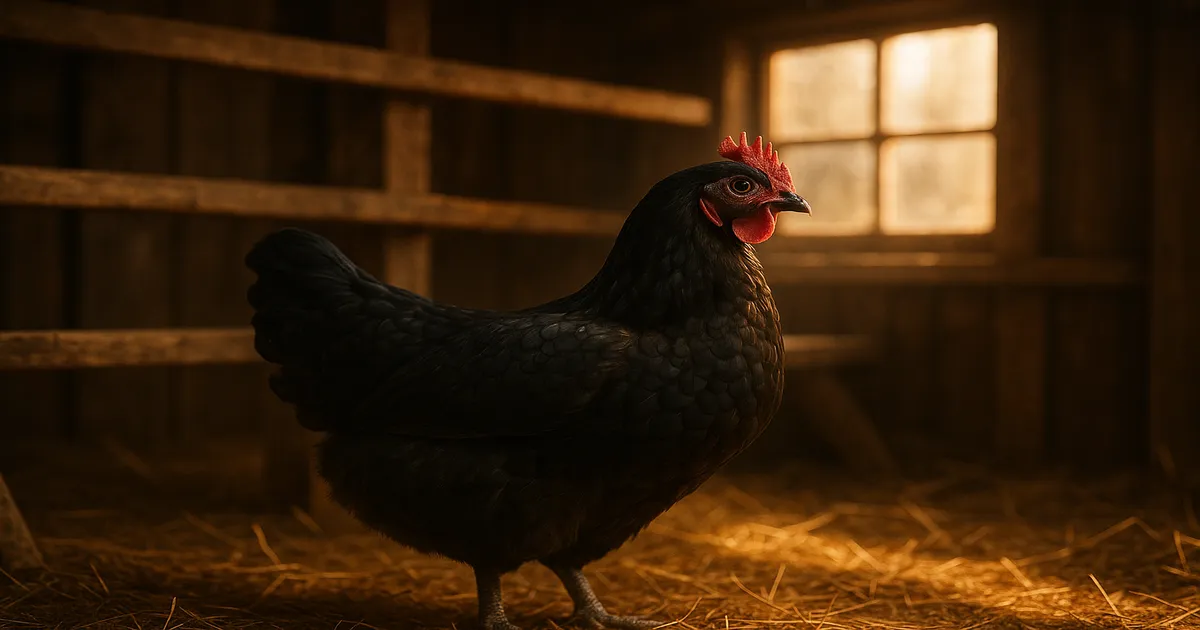
Quick Answer: An Australorp chicken is a large, dual-purpose Australian breed developed from Black Orpington stock in the early 1900s. Known for holding the world egg-laying record of 364 eggs in 365 days, Australorps are calm, beginner-friendly birds that reliably produce 250–300 brown eggs per year. They’re one of the most consistently recommended breeds for backyard flocks.
What Is an Australorp Chicken?
The Australorp is one of those rare breeds that genuinely earns every bit of its reputation. Developed in Australia from imported Black Orpingtons crossed with several high-production breeds, the Australorp was purpose-built to be a productive, practical farm bird — and it delivered spectacularly. The name is a contraction of “Australian Black Orpington,” and the American Poultry Association (APA) officially recognized the breed in 1929.
What sets the Australorp apart isn’t just the legendary egg record. It’s the combination of serious laying output, a calm temperament, and real adaptability to backyard life that keeps this breed near the top of recommended lists year after year.
Key Facts at a Glance
| Feature | Details |
|---|---|
| Origin | Australia (1890s–1920s) |
| Classification | Heavy breed, English class, dual-purpose |
| Rooster weight | 8.5 lbs (3.9 kg) |
| Hen weight | 6.5 lbs (2.9 kg) |
| Egg color | Light brown to pinkish-brown |
| Eggs per year | 250–300 |
| Eggs per week | 4–5 |
| Temperament | Calm, docile, beginner-friendly |
| Cold hardiness | Moderate to good (down to 0°F / -18°C) |
| APA recognized variety | Black only |
Australorp Breed History and Origin
From English Orpington to Australian Icon
The story starts in England. William Cook developed the Orpington in the 1880s as a dual-purpose bird, and Australian farmers began importing Black Orpingtons in the 1890s. They quickly saw the breed’s potential but found the English strain too meat-focused and not productive enough on the egg side.
Australian breeders crossed Black Orpingtons with Rhode Island Reds, Minorcas, White Leghorns, Langshans, and Plymouth Rocks. The goal was straightforward: keep the Orpington’s size and temperament while dramatically boosting egg output. Over roughly three decades of selective breeding, they succeeded beyond anyone’s expectations.
The 1922–1923 World Record
The moment that put Australorps on the global map came during Australian utility trials in 1922–1923. A single Australorp hen laid 364 eggs in 365 days — a world record that still stands. Six hens in the same trial averaged 309.5 eggs each over the same period. Those numbers sent shockwaves through the poultry world and triggered massive export demand almost overnight.
The APA added the Australorp to the Standard of Perfection in 1929. By that point, the breed had already proven itself on three continents.
Australorp Appearance and Recognized Varieties
Physical Characteristics
The Australorp is a big, upright, full-bodied bird with a deep chest and a compact, muscular frame. Hens weigh 6.5 lbs and roosters 8.5 lbs — solid birds that feel substantial in hand. The single comb has 5–7 points and sits upright; roosters carry a slightly larger version. Legs are clean (no feathering), dark slate to black, with a dark beak to match.
The Beetle-Green Sheen
The black plumage is tight and close-fitting, but what really catches the eye is what happens in direct sunlight. Feathers shift from flat black to a brilliant, iridescent beetle-green sheen that’s genuinely striking. It’s one of the breed’s most distinctive features and a quick way to spot a well-bred Australorp from across the yard.
Blue, White, and Bantam Australorps
In the United States, only the Black variety is APA-recognized. Australia and South Africa also recognize Blue and White Australorps, which share the same body type and temperament but lack the iridescent sheen. A Bantam Australorp also exists, weighing around 2–2.5 lbs, with proportionally similar laying behavior but smaller eggs.
Hatchery Birds vs. Breed-Standard Australorps
Most hatcheries sell Australorps that make perfectly good backyard chickens but may not meet strict breed standards for body shape, sheen quality, or comb type. For egg production and temperament, hatchery birds are usually fine. If showing or genetic preservation matters to you, seek out a breeder who works to the APA Standard of Perfection.
Australorp Temperament and Behavior
Australorps are consistently ranked among the gentlest large breeds available. They’re calm, tolerant of handling, and many will become outright lap chickens with regular socialization starting in the brooder. That makes them an excellent choice for families with children or anyone new to keeping chickens.
In a mixed flock, Australorps typically settle into the middle of the pecking order — not bullies, not pushovers. They coexist peacefully with other calm breeds. Noise-wise, they’re quiet to moderate. Hens produce the usual egg-song, but they’re not the chronic loud talkers that some Mediterranean breeds can be, which makes them well-suited to suburban backyards.
Give an Australorp room to roam and she’ll use it enthusiastically. They’re active, curious foragers who genuinely enjoy scratching through grass and leaf litter. But unlike some highly active breeds, they also adapt well to a managed run without developing stress behaviors like feather-pecking — a flexibility that makes them practical for a wide range of setups.
Australorp Egg Production: What to Expect
Average Output
Under good management, expect 250–300 eggs per year — roughly 4–5 eggs per week per hen. Well-bred high-production lines can push toward 300–320 eggs annually, which is competitive with many breeds marketed primarily as layers.
Eggs are large to extra-large, typically 55–65 grams, with light brown to pinkish-brown shells and excellent shell quality. Hens with pasture access tend to produce noticeably richer, deeper-colored yolks.
When Do Australorps Start Laying?
Most pullets lay their first egg between 22–26 weeks (about 5.5–6.5 months). Some early-maturing lines start as young as 20 weeks. Full peak production is usually reached by 30–32 weeks.
Seasonal Production and Winter Laying
Like all chickens, Australorps respond to daylight hours. Production peaks in spring and summer, drops in fall, and can slow significantly — or stop — through winter without intervention. Adding 14–16 hours of light per day using a simple LED bulb keeps production near peak year-round. A timer-controlled coop light makes this effortless .
The annual molt, usually in fall, halts laying for 6–12 weeks regardless of lighting. Bumping protein to 18–20% during this period helps speed feather regrowth and get hens back to laying faster.
Broodiness
Australorps are low-to-moderately broody — more likely to sit than a Leghorn, less so than an Orpington or Silkie. When they do go broody, they make attentive, calm mothers. If egg production is your priority, break broodiness early by placing the hen in a wire-bottomed cage with good airflow for 3–5 days, which lowers her body temperature and interrupts the hormonal cycle driving the behavior.
Coop and Housing Requirements
Space Requirements
- Indoors (minimum): 4 sq ft per bird; recommended: 6 sq ft per bird
- Outdoor run (minimum): 10 sq ft per bird; recommended: 15–20 sq ft per bird
- Free-range: At least 250 sq ft per bird
Australorps are large birds, and cramped conditions lead to stress and reduced production. If you’re building new, go bigger — you’ll thank yourself later.
Roost Bars
Keep roost bars 18–24 inches off the floor. This is lower than you’d use for lighter breeds, and it matters. Australorps are heavy, and repeated hard landings from high roosts cause leg injuries and bumblefoot. Use 2–4 inch wide, flat or slightly rounded untreated pine, spaced 12 inches per bird along the bar. Avoid metal (too cold in winter) and thin round dowels that force feet into an unnatural grip.
Nesting Boxes
Standard 12×12-inch boxes work, but 14×14 inches is a better fit for Australorps. Plan for one box per 3–4 hens, mounted 18–24 inches off the floor — always lower than the roost bars. Add 3–4 inches of clean straw or pine shavings, and consider partial curtains. Hens lay more consistently when they feel hidden.
Ventilation and Winter Management
Ventilate at 1 sq ft per 10 sq ft of floor space, positioned high on walls or in the roof so moisture and ammonia escape without creating drafts at bird level. In winter, resist the urge to seal everything up — moisture buildup causes frostbite and respiratory disease far more than cold temperatures do.
Australorps handle cold down to 0°F (-18°C) without supplemental heat. Their single comb is somewhat susceptible to frostbite in extreme conditions, so a dry, well-ventilated coop matters more than added warmth. Supplemental heat is only warranted below 20°F (-7°C), and even then, use it cautiously — heat lamps are a leading cause of coop fires.
Predator-Proofing
- Bury hardware cloth 12 inches deep, bent outward at 90° to stop diggers
- Use carabiner clips or two-step latches — raccoons open simple hook-and-eye hardware easily
- Seal any gap larger than ½ inch (weasels fit through surprisingly small openings)
- Cover the run roof with hardware cloth or welded wire to block aerial predators
An automatic coop door adds a reliable layer of protection against nighttime predators .
Feeding and Nutrition for Australorp Chickens
Feed by Life Stage
- 0–8 weeks: 18–20% protein chick starter crumble
- 8–18 weeks: 16–18% protein grower/developer feed
- 18+ weeks (or at first egg): 15–18% protein layer pellets or crumble
Pellets reduce waste noticeably compared to mash and are worth choosing for adult birds. During molt or peak production, bump protein to 18–20% temporarily to support feather regrowth and shell quality.
Calcium and Oyster Shell
Eggshell formation requires roughly 2–2.5 grams of calcium per egg. Quality layer feed covers most of this, but offering free-choice crushed oyster shell in a separate container lets hens self-regulate their intake . Never offer oyster shell to birds under 18 weeks — excess calcium can damage developing kidneys. Crushed baked eggshells also work as a supplement; bake at 250°F (121°C) for 30 minutes and crush thoroughly before offering.
Treats, Scratch, and Foods to Avoid
Treats and scratch grains should stay at or under 10% of total daily intake. Good options include mealworms (especially during molt), leafy greens, pumpkin, berries, and watermelon in summer. Scatter scratch in bedding rather than feeding from a bowl — it encourages natural foraging behavior and keeps birds busy.
Avoid: avocado (toxic — contains persin), chocolate, onions, raw dried beans, salty foods, and anything moldy.
Grit and Water
Confined birds need coarse granite grit offered free-choice at all times — without it, they can’t grind food in the gizzard effectively. Keep grit and oyster shell in separate containers; they do completely different jobs.
Adult hens eat 4–6 oz (113–170 grams) of feed per day. Provide at least 4 linear inches of feeder space per bird to prevent competition. Water needs run about 1 gallon per 4–5 birds daily in normal temperatures, jumping to 1 gallon per 2–3 birds above 90°F (32°C). In winter, use a heated waterer to keep water from freezing . Chickens drink far less when water is near freezing, which hurts both health and egg production.
Common Health Issues in Australorp Chickens
Marek’s Disease
Marek’s is a highly contagious herpesvirus that causes tumors, leg and wing paralysis, and a characteristic gray clouding of the eye. Most hatcheries vaccinate chicks at one day old — confirm this when ordering. The vaccine prevents tumor formation but doesn’t stop infection or shedding, so biosecurity still matters. There’s no treatment; severely affected birds should be humanely culled.
Coccidiosis
Coccidiosis is most dangerous in chicks between 3–6 weeks old. Watch for bloody or watery droppings, lethargy, ruffled feathers, and a pale comb. Treat with Amprolium (Corid) in drinking water — 9.6% solution at 2 teaspoons per gallon for 5–7 days. Medicated chick starter contains a preventative dose of amprolium and is a reasonable choice if brooder conditions are challenging. Keep the brooder dry and uncrowded — wet litter is the primary driver of outbreaks.
Mites and Lice
Inspect birds monthly by parting feathers near the vent and under the wings. Northern fowl mites stay on the bird year-round; red roost mites hide in coop crevices during the day and feed at night. Both cause feather damage, restlessness, pale combs, and reduced laying. Treat with permethrin dust or spray applied to both birds and the coop, and repeat in 7–10 days to break the egg cycle. Providing a proper dust bath area — at least 12×12 inches per 4 birds — is your best ongoing prevention.
Bumblefoot
Australorps’ heavy body weight puts them at higher risk for bumblefoot than lighter breeds. It starts as a small cut or abrasion on the footpad that becomes infected with Staphylococcus aureus, eventually forming a hard, black-scabbed lesion. Affected birds will limp and avoid walking. Caught early (Grade 1–2), soak the foot in warm Epsom salt solution for 10–15 minutes, apply Vetericyn or plain Neosporin (without pain-relief additives, as these can be harmful to birds), and wrap with vet wrap. Repeat daily until healed. Keeping roost bars at the recommended 18–24 inch height is your best prevention.
Frequently Asked Questions About Australorp Chickens
How many eggs does an Australorp chicken lay per year?
An Australorp lays approximately 250–300 eggs per year under good management — about 4–5 eggs per week. Well-bred high-production lines can push toward 320 eggs annually. The breed holds the all-time world record of 364 eggs in 365 days, set during Australian utility trials in 1922–1923.
Are Australorp chickens good for beginners?
Yes. Australorps are widely considered one of the best breeds for beginners. They’re calm, tolerant of handling, adapt well to both confinement and free-ranging, and produce eggs reliably without demanding specialized care. Their forgiving temperament makes the inevitable early mistakes far less stressful.
What is the difference between an Australorp and a Black Orpington?
Both breeds share common ancestry, but Australorps were specifically developed for much higher egg production. A Black Orpington typically lays 150–200 eggs per year, while an Australorp averages 250–300. Australorps are also slightly leaner in body type with a more upright posture, compared to the rounder, fluffier Orpington silhouette.
Do Australorp chickens go broody?
Australorps have a low-to-moderate tendency to go broody — less frequently than Orpingtons or Silkies, but more so than Leghorns. When they do go broody, they’re attentive and calm mothers. To maintain egg production, break broodiness early using the wire-bottomed cage method for 3–5 days.
How cold-hardy are Australorp chickens?
Australorps are moderately cold-hardy and can tolerate temperatures down to 0°F (-18°C) with proper shelter. Their single comb is somewhat susceptible to frostbite in extreme cold, so good ventilation — not supplemental heat — is the most important factor. A dry, draft-free coop with adequate airflow protects them far better than a sealed, humid one.